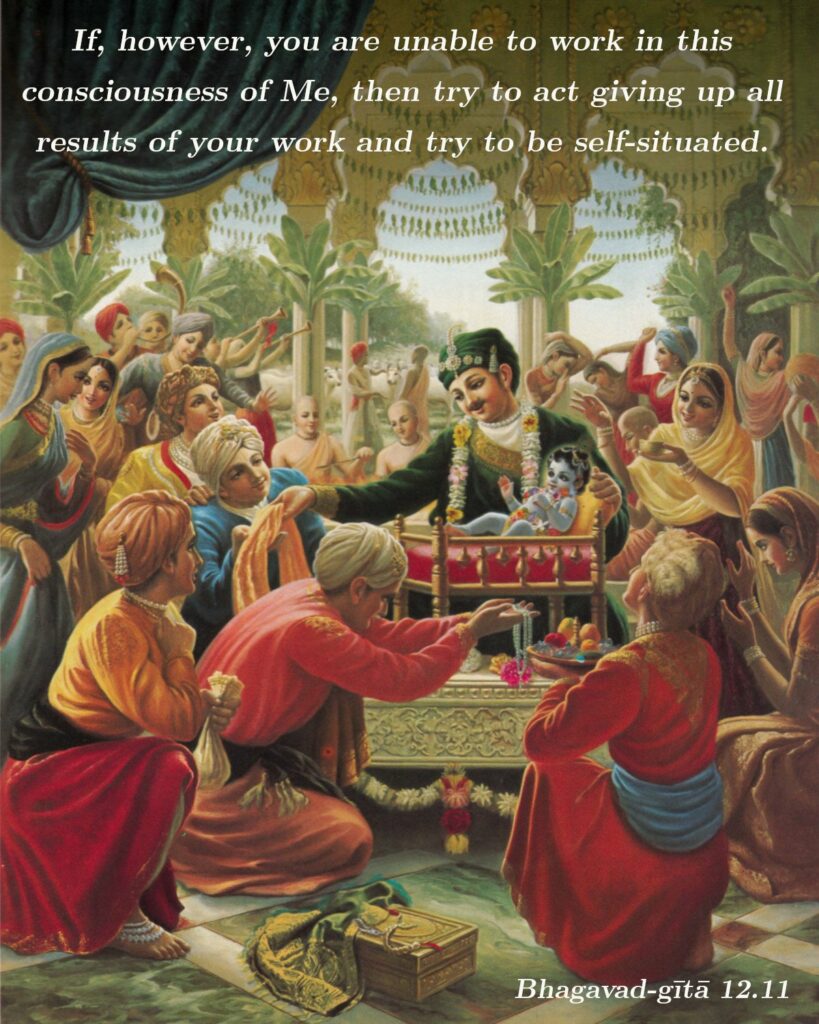
अथैतदप्यशक्तोऽसि कर्तुं मद्योगमाश्रित: |
सर्वकर्मफलत्यागं तत: कुरु यतात्मवान् || 11||
athaitad apy aśhakto ’si kartuṁ mad-yogam āśhritaḥ
sarva-karma-phala-tyāgaṁ tataḥ kuru yatātmavān
atha—if; etat—this; api—even; aśhaktaḥ—unable; asi—you are; kartum—to work; mad-yogam—with devotion to Me; āśhritaḥ—taking refuge; sarva-karma—of all actions; phala-tyāgam—to renounce the fruits; tataḥ—then; kuru—do; yata-ātma-vān—be situated in the self
Translation:
If you are not able to do My yoga taking refugee in Me, then renounce all actions and the fruits there of, self-controlled.
Commentary:
The Lord suggests the easiest of all paths here. Man is engaged in a hundred actions day and night in the course of his life. While performing these actions, let him remember God, think of Him as the doer and himself a mere instrument, and surrender all works and their fruits entirely to God. That is, all work should be done in a spirit of self-surrender to God. Bad actions are not included here, because they are already prohibited by the Sastras. No one should do sinful acts. Worship of God, singing His name and glory, charity, works of social welfare, all these are good actions and they should be surrendered to God. (Isvararpanam, Ramarpanam, or Krishnarpanam). As several paths are suggested, each man may take up any practice suitable to his physical and mental predisposition. This last path is within the reach of all persons. While walking, let it be thought of as pradakshinam of God. While talking let it be thought of as singing His glory. This may be extended to all actions. By this, the Lord is constantly kept in view, and the mind, without any strain comes to entertain Godly ideas in a natural way. The Lord has already said “mamanusmara yudhya ca” – “Remember Me and fight.” So, this path is the easiest and the best-fitted for all sincere seekers on the spiritual path. All sin is destroyed, the mind becomes pure, and liberation is attained ultimately.
yatatmavan: The seeker should be self-controlled. Without it, the constant memory of God and self-surrender to Him are not possible. So the least that man can do is to cultivate that degree of self-control to remember the Lord while carrying on the various activities of life and surrender the fruits of actions to Him.
A FARMER-SAINT
Many great devotees have lived this teaching. There was a saint in our native place. He lived alone, constantly chanting the nāma, cooking for himself and never depending on anyone for anything. Most of his day was spent toiling at a nearby banana orchard, caring for the plants with great effort. He would draw water from a well and tend to all the plants. This he would do every day. When the bananas were ready to be harvested, he would collect them and give them away to the villagers and the temple. The harvest was shared with everyone, and naturally, they were happy to get these free bananas. This continued for many years.
One year, as usual, he was seen toiling in the orchard. One day, some of us found that the bananas were no longer there on the plants, yet we children had not received any either. The saint did not explain to anyone the reason for this. Of course, we knew that he would not have sold them. When this happened several times, we asked him what had happened to the fruits. He casually replied that someone had taken them away. When we asked whether they had been stolen, he replied, “You may call it stealing, but I will not. For me, all this effort is not work but a form of worship. I bring bananas to all your houses; perhaps, even if you do not want them, you accept them because I offer them with love. At times, I have seen them remaining uneaten and decaying. But now, God is coming in some form and taking them away Himself. I am happy that someone is using these bananas and benefiting from them. Hence I work with more enthusiasm now. Also, He has made it easier for me, as I need not carry them to your houses and distribute them myself. It is out of His compassion that the Lord comes in some form and takes them away at night.” We were astounded to hear these words. We felt that even the thief would wonder why this man never tried to stop him or even enquired about the missing bananas. This is an instance of karma-phala-tyāga. Literally phala-tyāga!
TAMIL SAINTS
We know of many stories of devotees who gave a portion of their karma-phala to the Lord. Among the great Tamil saints, there was a potter. Making and selling pots was his livelihood. It was his sādhanā or an expression of his devotion that in every set that he made, the first lot of the pots would be offered to the devotees of the Lord. After making the pots, he would go searching for saints, and with utmost devotion, bow down at their feet and offer his pots to them. This he did with such devotion that once the Lord Himself appeared as a monk, received a pot from him and blessed him with divine vision. Yet another devotee was a tailor. To him, the Lord appeared as a saint and gave His loincloth to the tailor for darning. This blessed the devotee with the ultimate divine experience.
THE SAINT AT NOOTRONDRU CAVE
The place where this commentary is being written now is an ashram in a remote village. About a few miles from this village is a cave called Nootrondru, which means one hundred and one. Until a few years ago, a saint used to live here. Apart from his daily spiritual practices, he distributed food to many. Since he himself was poor, the meals were not sumptuous but something simple made of rāgi (local millet) grains. He would feed a hundred poor people daily, considering them the Lord Himself. He continued this for a long period. And the story goes that one day the Lord Himself appeared as the 101st person, received the food from him and then revealed Himself. That place has been aptly named Nootrondru or one hundred and one. The whole place is vibrant with divine presence even today.
These are all examples of how our own svadharma, livelihood, can be transformed as a spiritual practice. Of course, only an upāsaka who meditates on the Lord, chants His name and has a link with the Divine can transform his actions as an offering. This offering of karma to the Lord is ‘Karma Yoga.’ It is not a mechanical practice which can be done by an atheist. It is possible only for a devotee because the action has to be offered to the Lord. This is an auxiliary practice to take one to deeper meditation. (Source: Srimad Bhagavad Gita – Elixir of Eternal Wisdom | Vol 3)
Question: What is the way for those who are not competent to do actions for His sake?
Answer: Self-controlled, man should surrender all actions with the fruits thereof to God. This is the least way for all people who are not competent for higher plights of yoga.
Bhagavad Gita: Chapter 12 🔻 (20 Verses)