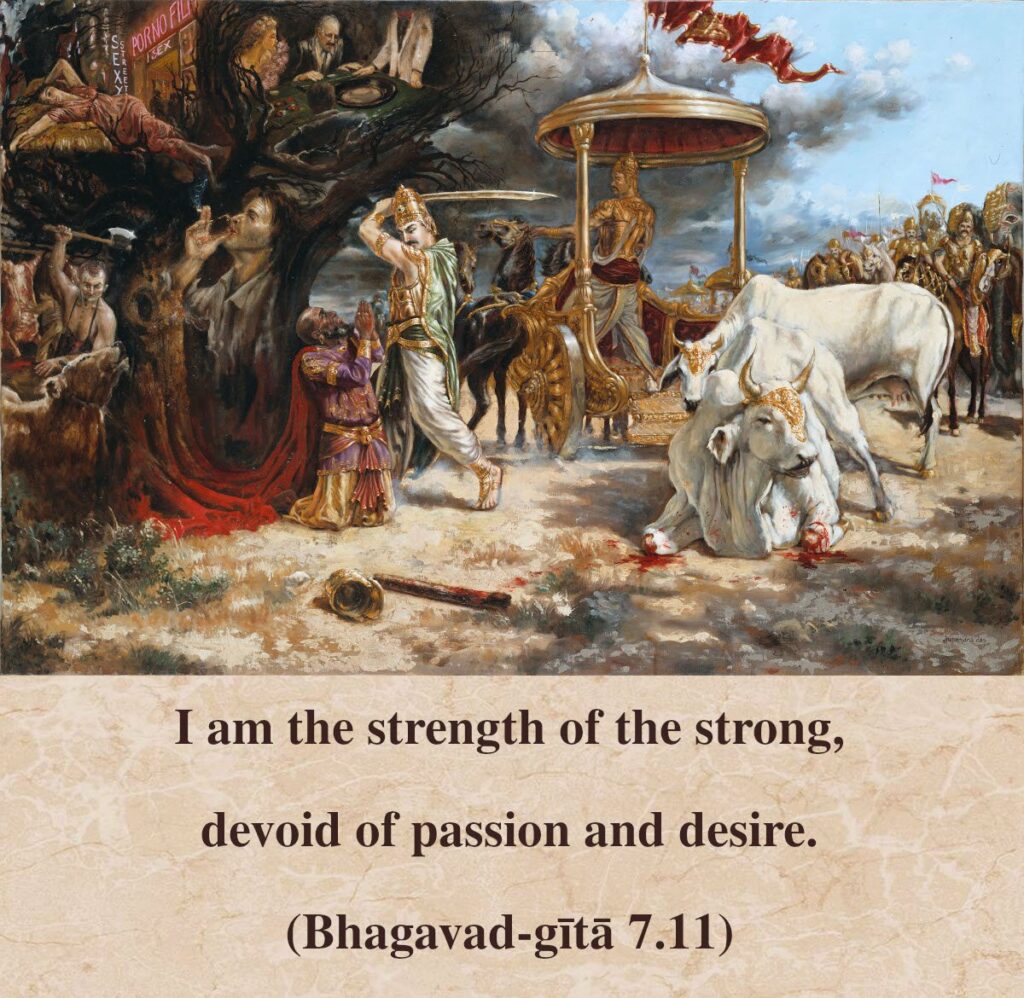
बलं बलवतां चाहं कामरागविवर्जितम् |
धर्माविरुद्धो भूतेषु कामोऽस्मि भरतर्षभ || 11||
balaṁ balavatāṁ chāhaṁ kāma-rāga-vivarjitam
dharmāviruddho bhūteṣhu kāmo ’smi bharatarṣhabha
balam—strength; bala-vatām—of the strong; cha—and; aham—I; kāma—desire; rāga—passion; vivarjitam—devoid of; dharma-aviruddhaḥ—not conflicting with dharma; bhūteṣhu—in all beings; kāmaḥ—sexual activity; asmi—(I) am; bharata-ṛiṣhabha—Arjun, the best of the Bharats
Translation:
I am the strength of the strong, free from longing and attachment. I am, Ο lord of the Bhāratas, the desire in all beings that is not contrary to dharma.
Commentary:
Strength is the glory of man, but it should be free from desire and passion. Strength should not be abused to satisfy sensual desires and greedy acquisition of worldly possessions. It should be expressed in doing good and benevolent acts, in the worship of the Divine, and in the pursuit of spiritual illumination. Whether it is intellectual or physical strength, if it is employed for selfish purposes to serve the lower impulses, it is wretched. In such cases, it is only demonical might, an asuric force, leading to self-destruction. The might of Ravana was impure by Kama, and it lead to his destruction and that of his people. So purity in strength, nobility in might, is what the Lord wants people to cultivate. His presence is felt in such strength.
The Lord is also ‘desire’ (kama) unopposed to Dharma. The desire to maintain one’s family in a good condition, to live in society without becoming a burden on others, to relieve the suffering of others – such desire, though it is kama, is the divine aspect of the Lord. There is no evil in such desire.
There are three distinct stages in the development of man. In the first stage, man’s desires instinctively run after sense-enjoyments and the gratification of lust and greed. In the second stage, desire becomes ennobled to the higher plane of selfless acts of service, generosity, and benevolence. It is then purified of its former evil. In the third and last stage, desires disappear from the mind when man realises the true Self. Then there are no desires, good or bad. It is true that Self realisation is not possible without giving up all desires. But man’s development is traceable from bad to good, and from good to the free state of Moksha. Here the Lord speaks of the second stage. Desires which agree with the Sastras, which do not run counter to Dharma, produce no evil effects. Gradually, man should rise to the ‘nirvikalpa‘ state of mind. Give up bad desires, and then give up all desires, and be thoroughly contented in the Self. This is the significance of the Lord’s statement here.
Sri Ramakrishna Says —
(To one of the sadhus) “Well, sir, one should be desireless; one should renounce all desires. Isn’t that so?”
SADHU: “Yes, sir.”
MASTER:“But I have the desire for bhakti. That is not bad. Rather, it is good. Sweets are bad, for they produce acidity. But sugar candy is an exception. Isn’t that so?”
SADHU: “Yes, sir.” (Source: Gospel of Sri Ramakrishna)
——
VIJAY: “If without destroying the ‘I’ a man cannot get rid of attachment to the world and consequently cannot experience samadhi, then it would be wise for him to follow the path of Brahmajnana to attain samadhi. If the ‘I’ persists in the path of devotion, then one should rather choose the path of knowledge.”
MASTER: “It is true that one or two can get rid of the ‘I’ through samadhi; but these cases are very rare. You may indulge in thousands of reasonings, but still the ‘I’ comes back. You may cut the peepal-tree to the very root today, but you will notice a sprout springing up tomorrow. Therefore if the ‘I’ must remain, let the rascal remain as the ‘servant I’. As long as you live, you should say, ‘O God, Thou art the Master and I am Thy servant.’ The ‘I’ that feels, ‘I am the servant of God, I am His devotee’ does not injure one. Sweet things cause acidity of the stomach, no doubt, but sugar candy is an exception. (Source: Gospel of Sri Ramakrishna)
—–
MASTER (to M.): “But one cannot realise God without renouncing ‘woman and gold’.”
M: “Why? Did not Vasishtha say to Rama, ‘O Rama, You may renounce the world if the world is outside God’?”
MASTER (smiling): “He said that to Rama so that Rama might destroy Ravana. Rama accepted the life of a householder and married to fulfil that mission.” (Source: Gospel of Sri Ramakrishna)
—–
MASTER: “Only the ego that is attached to ‘woman and gold’ is harmful. But the ego that feels it is the servant of God does no harm to anybody. Neither does the ego of a child, which is not under the control of any guna. One moment children quarrel, and the next moment they are on friendly terms. One moment they build their toy houses with great care, and immediately afterwards they knock them down. There is no harm in the ‘I-consciousness’ that makes one feel oneself to be a child of God or His servant. This ego is really no ego at all. It is like sugar candy, which is not like other sweets. Other sweets make one ill; but sugar candy relieves acidity. Or take the case of Om. It is unlike other sounds.
“With this kind of ego one is able to love Satchidananda. It is impossible to get rid of the ego. Therefore it should be made to feel that it is the devotee of God, His servant. Otherwise, how can one live? How intense was the love of the gopis for Sri Krishna! (To Captain) Please tell us something about the gopis. You read the Bhagavata so much.” (Source: Gospel of Sri Ramakrishna)
Bhagavad Gita: Chapter 7 🔻 (30 Verses)