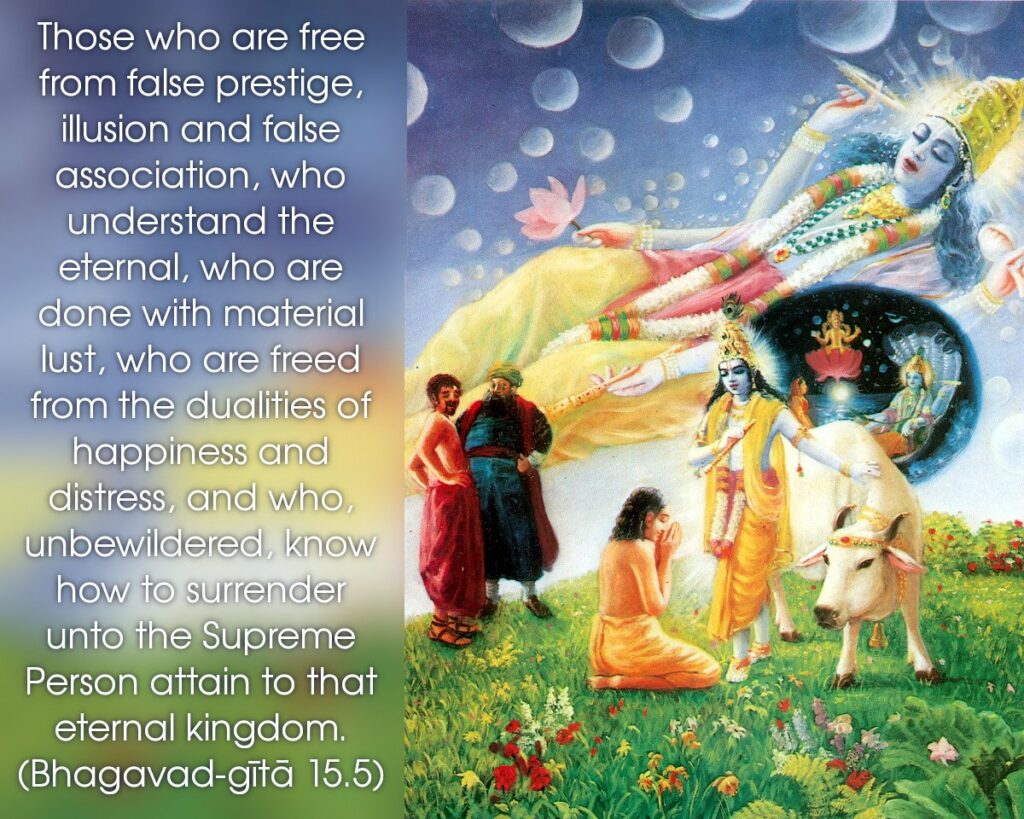
निर्मानमोहा जितसङ्गदोषा
अध्यात्मनित्या विनिवृत्तकामा: |
द्वन्द्वैर्विमुक्ता: सुखदु:खसंज्ञै
र्गच्छन्त्यमूढा: पदमव्ययं तत् || 5||
nirmāna-mohā jita-saṅga-doṣhā
adhyātma-nityā vinivṛitta-kāmāḥ
dvandvair vimuktāḥ sukha-duḥkha-sanjñair
gachchhanty amūḍhāḥ padam avyayaṁ tat
niḥ—free from; māna—vanity; mohāḥ—delusion; jita—having overcome; saṅga—attachment; doṣhāḥ—evils; adhyātma-nityāḥ—dwelling constantly on the self and on God; vinivṛitta—free from; kāmāḥ—desire to enjoy senses; dvandvaiḥ—from the dualities; vimuktāḥ—liberated; sukha-duḥkha—pleasure and pain; saṁjñaiḥ—known as; gachchhanti—attain; amūḍhāḥ—unbewildered; padam—abode; avyayam—eternal; tat—that
Translation:
Free from pride and delusion, having conquered the evil of attachment, ever devoted to the Supreme Self, with desires completely stilled, liberated from the pairs of opposites known as pleasure and pain, the undeluded reach that Immutable Goal.
Commentary:
In this verse, the qualities of the wise who attain the non-returning state Moksha, are clearly described. Six qualities are mentioned
(1) Freedom from pride (ahamkara) and delusion,
(2) Conquest of the evil of attachment to the sense-world. ‘Sanga’ is attachment; it is evil. This evil should be given up by detachment and dispassion.
(3) adhyatmanityah: Dwelling constantly in the Self. Here the word ‘nitya‘ is to be noted. Constant memory and understanding are necessary. At first, the seeker spends some time in Atma nishta and then he comes out into the objective world. This period of Self-centred meditation should be extended gradually till he is firmly established in the Self always. Constancy is emphasised many times by the Lord, because ‘avidya’ overtakes man the moment when he forgets Atma. To forget Atma is itself ‘Avidya’. So, constancy is prescribed as a rule for the seekers. We come across three types of men in the world. The first and the highest are those who are constantly in contact with Self; the second are those who contemplate Atma for some time, and then go into worldly activities; and the third are those who remain immersed in worldly life always. The second type have the opportunity of rising to the highest state. The third type of people are the lowest and most miserable. They are plunged in ignorance and totally devoid of any enlightenment what-so-ever.
4) Vinivrittakamah: This, the fourth quality is essential for all seekers. This is combined with ‘adhyatmanityah‘ in the same line in the verse. The two qualities are thus brought together, and they are the very essence of enlightenment. The aspirants for Moksha should repeat this line, think of it, meditate on the idea and model their life accordingly. The first is tathvajnanam and the second is Vasanakshyam‘. So the line ‘adhyatma nitya vinivritha kamah’ is the sum and substance of all spiritual practice. The first is the state of dirsyarahitvam‘. The Sastras declare that both these are to be practised simultaneously. In fact, they are the two sides of the same coin (Moksha). When Drik (Atman) is attained, there is no Drisyam.
(5) Freedom from the pairs of opposites, known as pleasure and pain.
(6) Amudhah: Freedom from delusion. The spiritual sadhana undertaken constantly keeps away delusion, and thus the sages live in the light of perfect knowledge.
What is the reward of following the above practices? People reach the immortal state of Paramatma. They leave away all other things as they are unreal, impure, sorrow-breeding, and perishable.
Swami Vivekananda Says —
Don’t be fools always wandering from place to place; that’s all very good, but be heroes. “Free from pride and delusion, with the evil of attachment conquered, ever dwelling in the Self, with desires completely receded, liberated from the pairs of opposites known as pleasure and pain, the undeluded reach that Goal Eternal.” Who advises you to jump into fire? If you don’t find the Himalayas a place for sadhana, go somewhere else then. So many gushing inquiries simply betray a weak mind. Arise, ye mighty one, and be strong! Work on and on, struggle on and on![Source]
Sri Ramakrishna Says —
MASTER: “God has covered all with His maya. He doesn’t let us know anything. Maya is ‘woman and gold’. He who puts maya aside to see God, can see Him. Once, when I was explaining God’s actions to someone, God suddenly showed me the lake at Kamarpukur. I saw a man removing the green scum and drinking the water. The water was clear as crystal. God revealed to me that Satchidananda is covered by the scum of maya. He who puts the green scum aside can drink the water.
“Let me tell you a very secret experience. Once I had entered the wood near the pine-grove, and was sitting there, when I had a vision of something like the hidden door of a chamber. I couldn’t see the inside of the chamber. I tried to bore a hole in the door with a nail-knife, but did not succeed. As I bored, the earth fell back into the hole and filled it. Then suddenly I made a very big opening.”
Uttering these words, the Master remained silent. After a time he said: “These are very profound words. I feel as if someone were pressing my mouth. … I have seen with my own eyes that God dwells even in the sexual organ. I saw Him once in the sexual intercourse of a dog and a bitch.
“The universe is conscious on account of the Consciousness of God. Sometimes I find that this Consciousness wriggles about, as it were, even in small fish.”
The carriage came to the crossing at Shovabazar in Calcutta. The Master continued, saying, “Sometimes I find that the universe is saturated with the Consciousness of God, as the earth is soaked with water in the rainy season.
“Well, I see so many visions, but I never feel vain about them.”
M. (with a smile): “That you should speak of vanity, sir!”
MASTER: “Upon my word, I don’t feel vanity even in the slightest degree.”
M: “There once lived a man in Greece, Socrates by name. A voice from heaven said that he was wise among men. Socrates was amazed at this revelation. He meditated on it a long time in solitude and then realised its significance. He said to his friends, ‘I alone of all people have understood that I do not know anything.’ But every man believes he is wise. In reality all are ignorant.”
MASTER: “Now and then I think, ‘What is it I know that makes so many people come to me?’ Vaishnavcharan was a great pundit. He used to say to me: ‘I can find in the scriptures all the things you talk about. But do you know why I come to you? I come to hear them from your mouth.'”
M: “All your words tally with the scriptures. Navadvip Goswami also said that the other day at the festival at Panihati. You told us that day that by repeating the word ‘Gita’ a number of times one reverses it and it becomes ‘tagi’, which refers to renunciation. Renunciation is the essence of the Gita. Navadvip Goswami supported your statement from the grammatical standpoint.”
MASTER: “Have you found anyone else resembling me — any pundit or holy man?”
M: “God has created you with His own hands, whereas He has made others by machine. All others He has created according to law.”
MASTER (laughing, to Ramlal and the other devotees): “Listen to what he is saying!”
Sri Ramakrishna laughed for some time, and said at last, “Really and truly I have no pride — no, not even the slightest bit.” (Source: Gospel of Sri Ramakrishna)
Question: What is the state of Paramatma?
Answer: It is unchanging and eternal.
Question: Who can attain it?
Answer: He who acquires the above six qualities.
Bhagavad Gita: Chapter 15 🔻 (20 Verses)