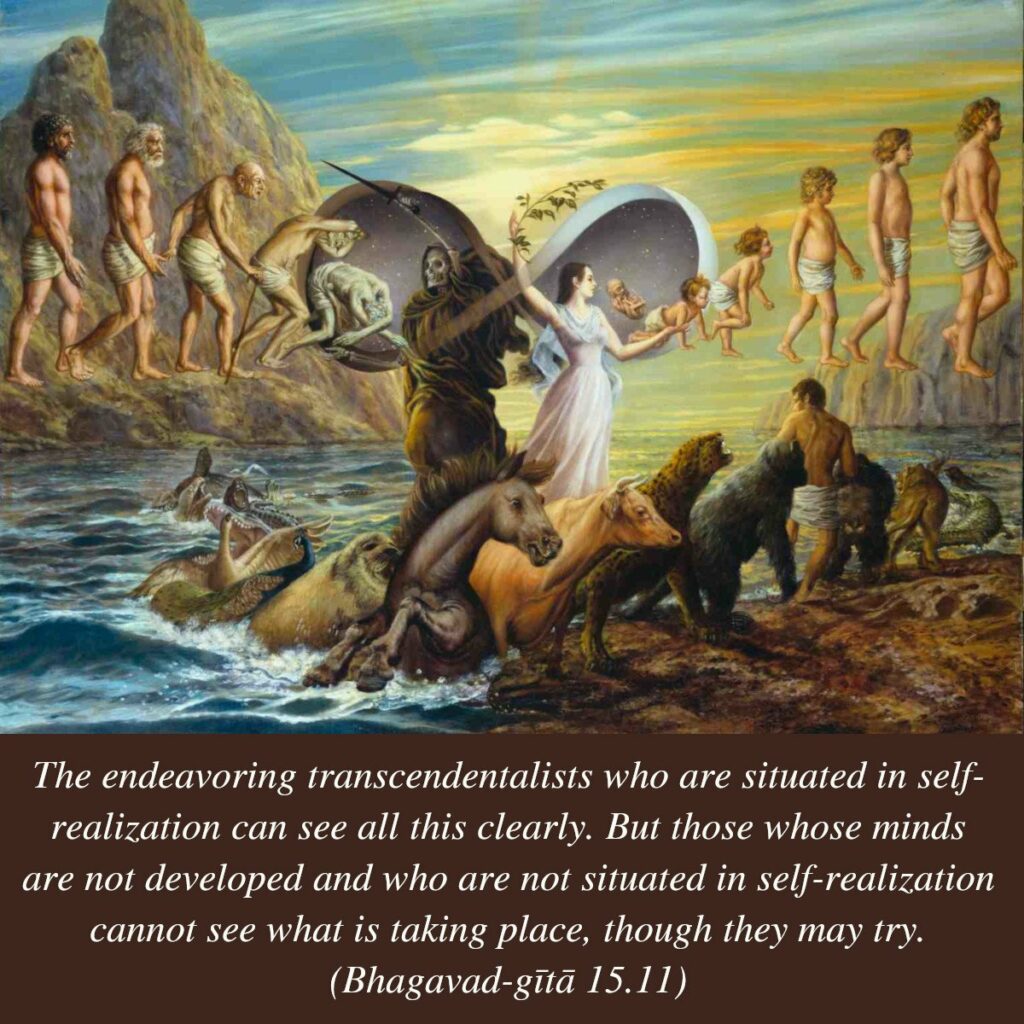
यतन्तो योगिनश्चैनं पश्यन्त्यात्मन्यवस्थितम् |
यतन्तोऽप्यकृतात्मानो नैनं पश्यन्त्यचेतस: || 11||
yatanto yoginaśh chainaṁ paśhyanty ātmany avasthitam
yatanto ‘py akṛitātmāno nainaṁ paśhyanty achetasaḥ
yatantaḥ—striving; yoginaḥ—yogis; cha—too; enam—this (the soul); paśhyanti—see; ātmani—in the body; avasthitam—enshrined; yatantaḥ—strive; api—even though; akṛita-ātmānaḥ—those whose minds are not purified; na—not; enam—this; paśhyanti—cognize; achetasaḥ—unaware
Translation:
Those who strive, armed with yoga, behold him dwelling within themselves; but the undisciplined and the thoughtless do not perceive him, though they strive.
Commentary:
The Lord explains why some yogis are able to behold the Atma, whereas others fail in their efforts. The effort is common in both cases. Why should some succeed and others fail? The impure-minded people (akritatmah) do not see the Atma, in spite of their sadhana. These also do japa, dhyana and other practices, but they fail because the heart is impure, (i.e. vitiated by powerful vasanas binding them to the external world). Some people attempt to realise Atma by a Study of sastras, without eradicating the impurities of the heart. Some others carry on a show of external devotion and meditation. They do not possess real self-control, and so they fail in their search for Paramatma. We hear that the Lord insists on purity of heart as the essential condition for Atmajnana. If there is no Purity, there is no Atmajnana. When Purity is attained, Atma is realised. The path is clear.
The field should be cleared of rubbish, properly tilled and watered and then the seeds grow and the harvest is gathered. Otherwise, the seeds are buried in the earth and have no chance of sprouting into life. They are wasted, for no harvest is gathered from that untilled, unwatered field (kshetram).
The four elementary principles of sadhana (sadhana chatushtaya) should be cultivated first. The heart is then purified of its unholy desires, passions, and emotions. The bodily organs and the sense organs and the mind are brought under control. When these disturbing forces are kept under check, the mind is full of peace and in that state, the enquiry into the Self continues without any hindrance and Self-realisation easily possible.
The Lord makes it clear that two things are needed (1) Effort, (2) Purity. ‘Yatantah’ – the yogis strive to discover the truth, Atma. The striving must be there for Self-realisation. Without it, nothing can be gained. But this striving should be accompanied with Purity (Chita-suddhi). Then the reward is immediate. The word ‘achetasah‘ does not here refer to illiterate, ignorant men who have no idea of spiritual life at all. It refers to persons who have some ideas of spirituality, who believe in God, who have studied the Sastras, and who understand the truth intellectually. These qualifications are good no doubt, but they are not enough for direct Self-realisation. They have to acquire self-control and dispassion (vairagya); otherwise, there is no progress. If the seekers do a bit of self-examination, they will find out how strong the bonds are which bind them to the objective world, and how weak their vairagya is. Let them concentrate on how to purify the heart of all its impure sensual tendencies. The company of the wise, the correct way of Sadhana, faith in the words of the Lord, all these are necessary for the aspirant to reach the goal.
Swami Vivekananda Says —
He who is continuously doing evil deeds, he whose mind is not calm, he who cannot meditates he who is always disturbed and fickle — he cannot understand and realise this Atman who has entered the cave of the heart.[Source]
Those who are evil-doers, whose minds area not peaceful, can never see the Light. It is to those whore are true in heart, pure in deed, whose senses are controlled, that this Self manifests Itself.[Source]
Swami Turiyananda: “As a bird flies to the sky with its two wings, so we must have the two wings of discrimina-tion and renunciation to climb to the edifice of liberation. If one has real discrimination and renunciation, one is safe. A man runs after water in a mirage only so long as he mistakes the mirage for real water. Once the delusion is broken, nobody goes after a mirage for water. The truth about it is that he only escapes whom the Mother Herself holds by the hand. Shri Ramakrishna used to say, ‘A finger-print is clear when the ink is all right, and if it is bad the impression also is bad.’ Spiritual instructions make a lasting impression on the mind that possesses discrimination and renunciation; and when there is a deficiency in these, the impression produced is proportionately small.” ….
“Nothing drops from the skies all of a sudden. Why don’t all have concentration? Because they don’t fulfil the conditions necessary for it, viz., absolute continence. This is known as strength. What can you expect of one who lacks this strength? The long and short of it is that one must have full self-control. The Gitâ says, ‘In My opinion Yoga is impossible for one who has no self-control. But one who has controlled his senses may, if he tries, get at it by adopting the proper means.’
“People follow their own whims and fail to get good results. The scriptures are there; but they won’t look into them. Nor would they listen to the teacher. In the end they become unfit for Yoga. ‘One who is moderate in food and pastime, in his effort for work, and in sleep and wakefulness-for such a man Yoga puts an end to all miseries.’
“If one has some disease, it will pass off; but one must keep his spiritual practices going.” (Source: Spiritual Talks by the First Disciples of Sri Ramakrishna)
- He who has not first turn away from wickedness, who is not tranquil and subdued and whose mind is not at peace, cannot attain Atman. It is realised only through the Knowledge of Reality. (Katha Upanishad 1.2.24)
Question: Where is Paramatma?
Answer: In one’s own Self.
Question: Who can s see Him?
Answer: He who practices Sadhana, having purity can see Him.
Question: Who cannot see Him?
Answer: Those who strive without purity of heart (Chitta suddhi) cannot see Him.
Question: So, what are the conditions for God-realisation?
Answer: Purity and effort.
Bhagavad Gita: Chapter 15 🔻 (20 Verses)