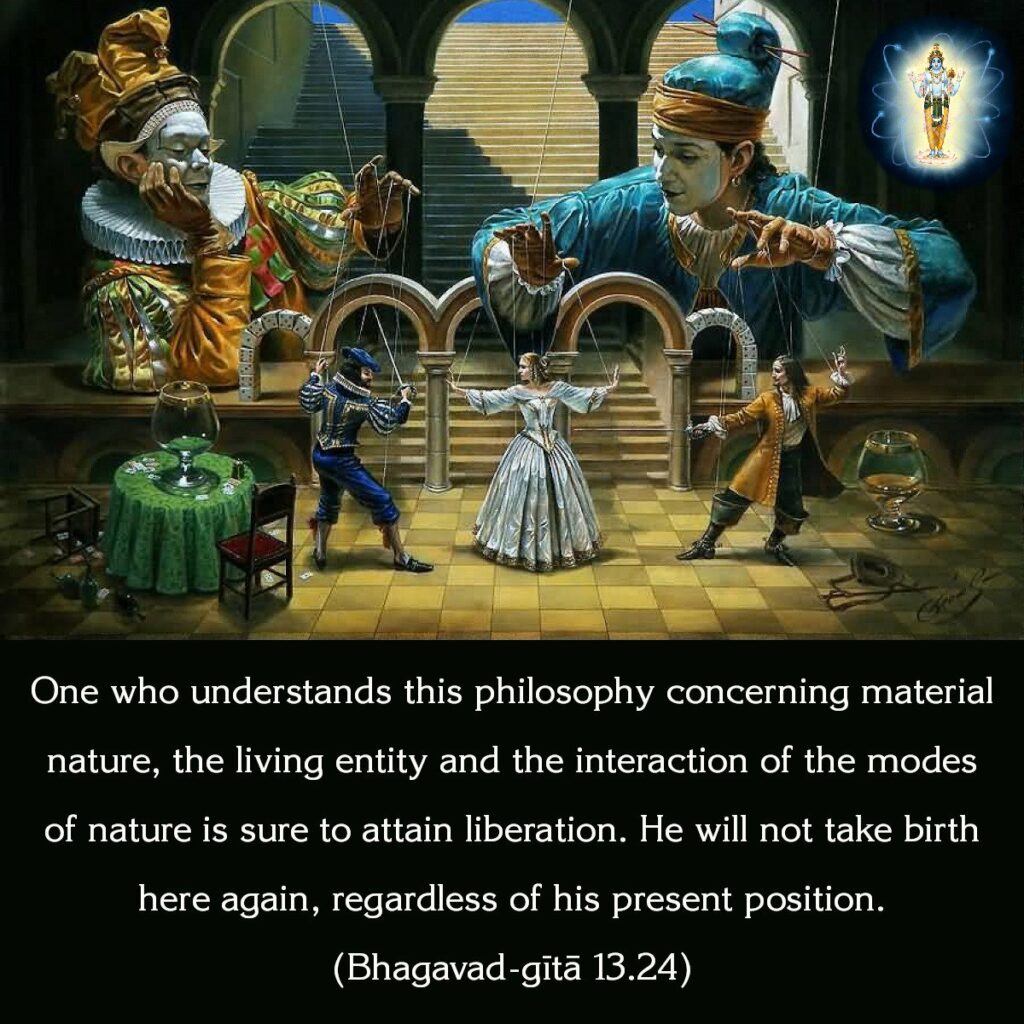
य एवं वेत्ति पुरुषं प्रकृतिं च गुणै: सह |
सर्वथा वर्तमानोऽपि न स भूयोऽभिजायते || 24||
ya evaṁ vetti puruṣhaṁ prakṛitiṁ cha guṇaiḥ saha
sarvathā vartamāno ’pi na sa bhūyo ’bhijāyate
yaḥ—who; evam—thus; vetti—understand; puruṣham—Puruṣh; prakṛitim—the material nature; cha—and; guṇaiḥ—the three modes of nature; saha—with; sarvathā—in every way; vartamānaḥ—situated; api—although; na—not; saḥ—they; bhūyaḥ—again; abhijāyate—take birth
Translation:
He who thus knows Purusha and Prakriti, along with the gunas, is not born again. He will be liberated regardless of his present condition.
Commentary:
The man of discrimination is able to see distinctly what Prakriti is and who Purusha is. Such a man knows that he is the Drik (seer) and Prakriti Drisya (seen). He also knows the qualities of Prakriti – sattva, rajas and tamas. He takes refuge, not in Prakriti, which causes bondage, birth, and all the ills of life, but in Atma, the Purusha, free and perfect, the blissful and the blessed. Detached from Prakriti, he attaches himself to Purusha. He is not born again. He is liberated. He is Jivanmukta.
sarvatha vartamanopi: The wise man who has released himself from the bondage of prakriti, may act in whatever way he wishes. He may be Sannyasi, absorbed in ‘samadhi’ always. Or he may be an active worker in the world doing many good works for the benefit of humanity. He may be a celebite or a house-holder. He has no birth again. We should understand that the word ‘sarvatha’ does not imply sinful deeds, prohibited by the sastras. In fact, the Lord has the qualities of knowledge, without which this supreme understanding cannot be obtained by anyone. Having obtained the knowledge of the Purusha the Jivanmukta can work in whatever way he likes for universal good or he may remain in absolute samadhi. This makes no difference for Him. He is ever free.
Sri Ramakrishna Says —
“The devotees who come here may be divided into two groups. One group says, ‘O God, give me liberation.’ Another group, belonging to the inner circle, doesn’t talk that way. They are satisfied if they can know two things: first, who I am (referring to himself); second, who they are and what their relationship to me is. (Source: Gospel of Sri Ramakrishna)
—–
It will be sufficient for the youngsters who come here if they know only two things. If they know these, they will not have to practise much discipline and austerity. First, who I am, and second, who they are. (Source: Gospel of Sri Ramakrishna)
Disciple: “Yes, sir. We had the discussion about ‘changefully eternal’ and ‘absolutely eternal’.”
Swami Turiyananda: “The very expression ‘changefully eternal’ sounds like ‘hot ice’. It is, I think, the Sankhya view. Prakriti consists of the three Gunas-Sattva, Rajas, and Tamas (balance, activity, and inertia). It is these which undergoing modification lead to creation. Dr. S. one day asked me this very question. He said, ‘The three Gunas make up Prakriti. So, if the Gunas undergo modification, does not Prakriti verily cease to be itself ?’ I replied, The whole of Prakriti is not of course undergoing modification, but only a portion of it. There is Prakriti, and there is also the modified Prakriti. As for instance, when milk is coagulat-ed into curd somewhere, all the milk in the world does not turn into curd-there is yet milk somewhere. Vedanta describes the purusha and Prakriti as identical. (Pointing to his own body) Even here don’t you find both Prakriti and Purusha existing together ?”…
“Even in a single grain there are two halves.
“The Purusha resting on Prakriti experi ences the attributes that spring from the latter. The attachment for the Gunas is the cause of the soul’s being born in higher and lower bodies.” (BG 13.22)
“He who thus knows the Purusha and the Prakriti together with its Gunas, is never subject to rebirth, howsoever he may live.” (BG 13.24)
Mirâ Bâi, when she went to Vrindaban, wanted to see Sanâtana, but the latter refused to grant her an interview on the ground that she was a woman. He was, you know, a man of great renunciation. Thereupon Mirâ replied, ‘At Vrindaban I know of only one Purusha (man), and he is Shri Krishna. And who is this second man that has come? Well, I must see him!’ Then they met. Both were advanced souls, so they were in raptures. (Source: Spiritual Talks by the First Disciples of Sri Ramakrishna)
[The terms Purusha and Prakriti, in Sankhya philosophy, mean the soul and Nature which, in its broad sense, is the material cause of the universe. Purusha is intelligent, unchanging, eternal, and infinite in number, and experiences happiness and misery etc. through falsely identifying itself with Prakriti which is insentient, ever-changing, and eternal, and contributes to the experience of the Purusha. Both are independent. In the culmination of its experience the Purusha knows that it is eternally aloof from Prakriti. This is Kaivalya or Liberation. The words Purusha and Prakriti have also got a second meaning-male and female.]
Question: What is the reward of knowing distinctly Prakriti and Purusha?
Answer: He is not born again, though he may live in whatever way he wishes.
Bhagavad Gita: Chapter 13 🔻 (35 Verses)