श्रीभगवानुवाच |
अभयं सत्त्वसंशुद्धिर्ज्ञानयोगव्यवस्थिति: |
दानं दमश्च यज्ञश्च स्वाध्यायस्तप आर्जवम् || 1||
अहिंसा सत्यमक्रोधस्त्याग: शान्तिरपैशुनम् |
दया भूतेष्वलोलुप्त्वं मार्दवं ह्रीरचापलम् || 2||
तेज: क्षमा धृति: शौचमद्रोहोनातिमानिता |
भवन्ति सम्पदं दैवीमभिजातस्य भारत || 3||
śhrī-bhagavān uvācha
abhayaṁ sattva-sanśhuddhir jñāna-yoga-vyavasthitiḥ
dānaṁ damaśh cha yajñaśh cha svādhyāyas tapa ārjavam
ahinsā satyam akrodhas tyāgaḥ śhāntir apaiśhunam
dayā bhūteṣhv aloluptvaṁ mārdavaṁ hrīr achāpalam
tejaḥ kṣhamā dhṛitiḥ śhaucham adroho nāti-mānitā
bhavanti sampadaṁ daivīm abhijātasya bhārata
śhrī-bhagavān uvācha—the Supreme Divine Personality said; abhayam—fearlessness; sattva-sanśhuddhiḥ—purity of mind; jñāna—knowledge; yoga—spiritual; vyavasthitiḥ—steadfastness; dānam—charity; damaḥ—control of the senses; cha—and; yajñaḥ—sacrifice; cha—and; svādhyāyaḥ—study of sacred books; tapaḥ—austerity; ārjavam—straightforwardness; ahinsā—non-violence; satyam—truthfulness; akrodhaḥ—absence of anger; tyāgaḥ—renunciation; śhāntiḥ—peacefulness; apaiśhunam—restraint from fault-finding; dayā—compassion; bhūteṣhu—toward all living beings; aloluptvam—absence of covetousness; mārdavam—gentleness; hrīḥ—modesty; achāpalam—lack of fickleness; tejaḥ—vigor; kṣhamā—forgiveness; dhṛitiḥ—fortitude; śhaucham—cleanliness; adrohaḥ—bearing enmity toward none; na—not; ati-mānitā—absence of vanity; bhavanti—are; sampadam—qualities; daivīm—godly; abhijātasya—of those endowed with; bhārata—scion of Bharat
Translation:
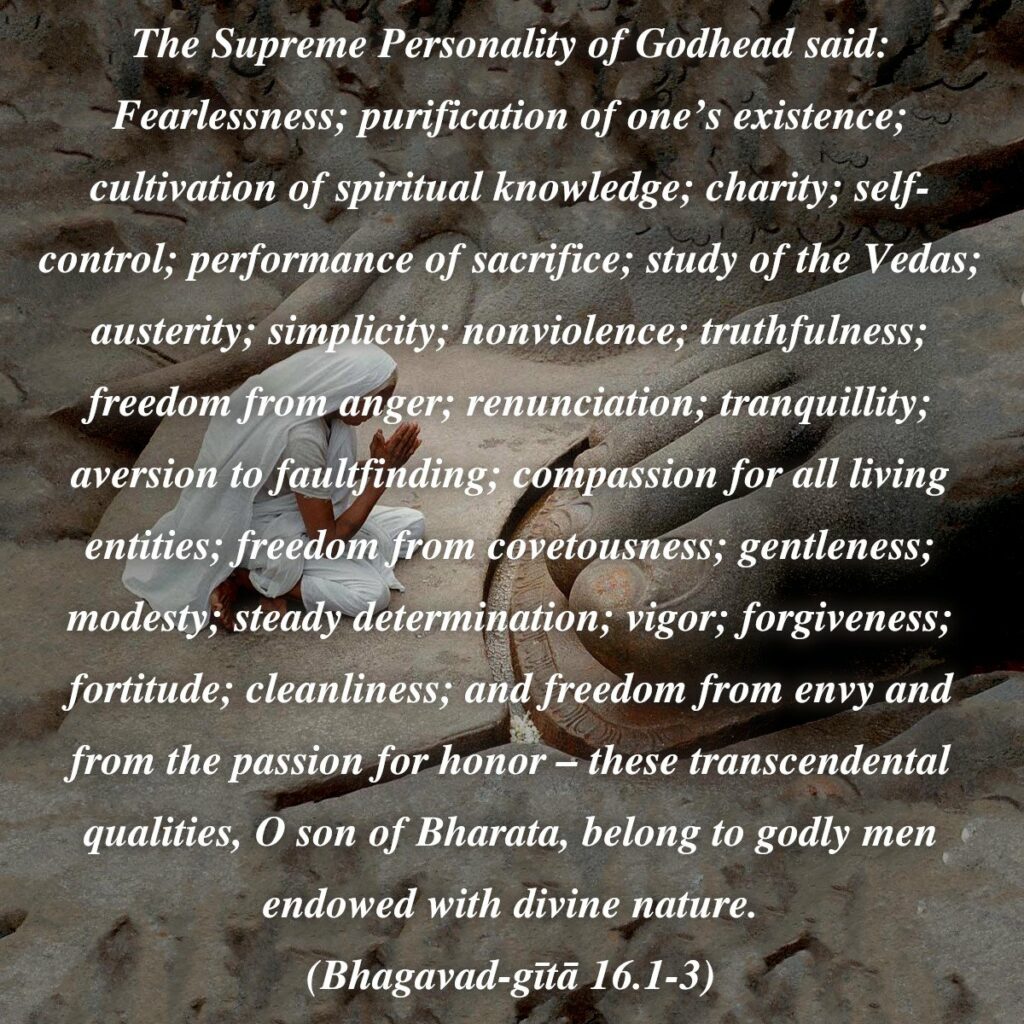
The Lord said: Fearlessness, purity of heart, steadfastness in knowledge and yoga, alms-giving, control of the senses, sacrifice, study of the Sastras, austerity, and straightforwardness.
Harmlessness, truth, absence of anger, renunciation, peacefulness, absence of crookedness, compassion to beings, absence of greed, gentleness, modesty, and absence of fickleness.
Energy, forgiveness, fortitude, purity, absence of hatred, and absence of over-pride, (these qualities) belong to one born of a divine state.
Commentary:
The Gita gives prominence to practise (sadhana). The spiritual goal is very near when the mind is purified. So the manner and means of purifying the mind are clearly stated in many places and here, ‘daivisampat’ is particularly intended to teach the disciple the science of self-purification. Twenty-six qualities are mentioned here. The aspirant for Moksha like the good student at his desk, should cultivate those qualities with determination and assiduous practice (abhyasa). He should not only acquire them but protect them as one would protect a treasure safely, never allowing anything to drop away from it.
Daivisampat is divine wealth, and the Lord scatters it among the people at large and says, “O ye mortals! Do not set your heart in worldly treasures, do not get entangled in the meshes of sense-enjoyments, for they shall cause misery birth after birth. Here are the precious jewels of spiritual illumination. Take them, take them all, for they are yours, and you shall be truly rich and wealthy when you possess them.” Therefore the wise and the thoughtful should quickly take hold of the treasure, and with the knowledge treasure attain oneness with Paramatma!
Abhayam: Among all the virtues, the Lord first takes up what may be described as the ‘lion’ among good qualities-fearlessness (abhayam). One should pause and think why fearlessness is given the first place among a number of other virtues equally great and adorable. (1) Fear is the source of all evil, and from fear arises all other bad qualities. Men cheat, betray, fight, kill, dominate, suppress truth, and do every evil thing, out of fear. All weakness is caused by fear. Man suffers misery by fear. Men cling to this life, wife and children, houses and positions on account of fear. The whose Samsara is built on fear. So if this tear is eradicated all other evil and weakness, disappear gradually. Fearlessness will bring with it all the other shining virtues which lead to liberation. So it is the virtue of daivisampat. In the game of Tug-of-war, the first man and the last man are selected for their strength and weight. In this tug-of-war with the evil forces, fearlessness is chosen as the captain to lead the team of virtues on the battle-field of everybody’s heart. The Upanishads declare that abhayam, is the state of Brahman.
Abhayam vai Janaka praptosi.
Thus, Abbayam, the first virtue declared by the Lord should be practised by every seeker for spiritual realisation.
Sattvasamsuddhih: Perfect purity of the mind is stated next. The mind should be as pure as the purest mirror. Not a speck of dust should be there. Not a trace of worldly thoughts, sensual tendencies, vicious inclinations should be there. As the mind gets pure, the Atmic light is clearly perceived in it. True knowledge and joy fills the mind.
Jnanayogavyavasthitah: Though different yogas are taught in the Gita, here and there the superior excellence of jnanayoga is mentioned as Atmajnana, which is the goal of spiritual life. (Sarvam karmakhilam Partha jnane parisamapyate.) All works and yogas culminate in jnana. Therefore the Lord mentions it in the beginning, and the seekers should take to knowledge and cross over delusion and ignorance.
Danam: Charity which includes every kind of help offered to others without expectation of any return from them. Gift of lands, money, food, water service, education, knowledge, all offerings come under, ‘danam.’
Damah: The control of the internal organs is included in ‘Sattva samsuddhih‘, and so here the control of external organs is mentioned. Self-restraint both internal and external is the pre-requisite of all spiritual progress. Proper emphasis is given to these virtues in the Gita.
Yajnah: Tapo-yajna, yoga-yajna, svadhyaya-yajna, jnana-yajna these are the yajnas most necessary for spiritual life.
Svadhyayah: The study of the Gita, Upanishads, Brahmasutras, Yoga-Vasishta, Bharata, Bhagavata, Ramayana, etc., and books of this type should be read and their essence absorbed through deep thought and meditation. This is Svadhyaya.
Tapah: This is explained in the 17th Discourse. It is absolute purity in word, thought and deed and not the mortification of the flesh.
Arjavam: Straight-forwardness in thought, word and deed. This is called ‘Trikaranasuddhi,’ – because thinking, speaking and acting form the triple function of all men. Where there is harmony among the three, there is truth. Poisonous reptiles are crooked in their movements, and hence if man is crooked in his character, he is like a reptile.
Ahimsa: Non-injury towards any creature in thought, word or deed.
Satyam: 1. Truth in thought word and deed, 2. Adherence in Atma, the One Reality.
Akrodhah: Absence of anger. Krodha is man’s deadly foe in every way. obsessed by it man loses all discrimination and destroys himself by cruel behaviour towards elders and Gurus. So the Lord has already warned man against it (Krodhat bhavati sammohah). Under its power man is transformed into a demon, horrible to look at, with red eyes, sweating, shaking abusing and attacking. Freedom from this Demon is therefore the primary duty of man in his life, both secular and spiritual.
Tyagah: Tyagenaike amṛtatva manasuḥ – By Tyaga alone, Moksha is attained – so says the Upanishads. Taking refuge in Paramatma by giving up attachment for objects is tyaga. Giving up evil thoughts, evil actions, evil ways of life, is tyaga. Renunciation of all desires for enjoyments is tyaga. Surrendering all the fruits of actions to God is tyaga. Internal renunciation is of more significance than formal external renunciation.
Santih: Peace, calmness of mind. The mind should be like a waveless lake and not like a turbulent ocean. Perfect peace is attained only when the mind merges in Atma. Where there is no peace there is no happiness (asantasya kutah sukham). Taking refuge in God and giving up desires is the way to peace.
Apaisunam: Not pointing out bad qualities in others, not carrying tales against others. Why should one concerned with the evil of others? It is enough if he cleanses his own heart filled with innumerable evils.
Daya bhuteshu: Kindness and compassion towards all beings are mentioned several in the Gita. Brahmajnana is most closely associated with universal compassion. The seekers should cultivate this virtue along with Bhakti, Jnana and Vairagya.
Alolatvam: Indulgence in several pleasures should be abandoned completely. The sense-organs lose their power by yielding to the temptations of the flesh and are incapacitated to think and grasp higher truths. So they should be withdrawn from sense-objects (pratyahara) and established in Atma. The mind should not waver from the chosen ideal.
Mardavam: Gentleness in word and deed. Hardness and harshness should be abandoned. This is the attitude of a man of Sattvic nature.
Hrih: This is the mark of an evolved human being. 1. He is ashamed of himself if he does anything wrong, when he utters a lie, or when he injures another, or when he acts contrary to Sastraic injunction. 2. The seeker should question himself about his spiritual progress, and when he has not made proper advance, he should feel ashamed of his niggardly and sluggish attempts in securing his own good. 3. When one comes across great men of purity and perfection, experienced in Brahmajnana, he should feel ashamed of himself, and strive for perfection like them.
Achapalam: The wandering mind should be brought to rest in Atma.
Tejah: The light of Brahman.
Kshama: Forbearance, forgiveness. One should think of God-men like Suka and their exceptional forbearance and love for all. When the pairs of opposites overtake him he should remain firm and unmoved.
Dhritih: The seekers should be steadfast and firm. As man thinks of the unreality of the world and the blessedness of Paramatma, he becomes bold and firm in all the functions of his life. Like the Meru mountain, he should be immovable under the most difficult circumstances.
Saucham: 1. External purity of the person, house etc., 2. Internal purity of the senses and the mind, and freedom from bad thoughts and feelings.
Adrohah: Abandoning hatred and betrayal of others.
Natimanita: One should not be proud and imagine that he should be adored and worshipped by others. This is a very important point for all seekers to remember. Lacking in this, many advancing souls in spiritual life have fallen down before attaining Self-realisation.
One should think of Hanuman, his humility and devotion, his egolessness, his utter self surrender to Rama. Such a man alone can achieve the Highest.
Thus Daivisampat includes twenty-six virtues. These should be cultivated carefully and assiduously by all people who wish to advance in spiritual life.
Sri Ramakrishna Says —
MASTER: “God has covered all with His maya. He doesn’t let us know anything. Maya is ‘woman and gold’. He who puts maya aside to see God, can see Him. Once, when I was explaining God’s actions to someone, God suddenly showed me the lake at Kamarpukur. I saw a man removing the green scum and drinking the water. The water was clear as crystal. God revealed to me that Satchidananda is covered by the scum of maya. He who puts the green scum aside can drink the water.
“Let me tell you a very secret experience. Once I had entered the wood near the pine-grove, and was sitting there, when I had a vision of something like the hidden door of a chamber. I couldn’t see the inside of the chamber. I tried to bore a hole in the door with a nail-knife, but did not succeed. As I bored, the earth fell back into the hole and filled it. Then suddenly I made a very big opening.”
Uttering these words, the Master remained silent. After a time he said: “These are very profound words. I feel as if someone were pressing my mouth. … I have seen with my own eyes that God dwells even in the sexual organ. I saw Him once in the sexual intercourse of a dog and a bitch.
“The universe is conscious on account of the Consciousness of God. Sometimes I find that this Consciousness wriggles about, as it were, even in small fish.”
The carriage came to the crossing at Shovabazar in Calcutta. The Master continued, saying, “Sometimes I find that the universe is saturated with the Consciousness of God, as the earth is soaked with water in the rainy season.
“Well, I see so many visions, but I never feel vain about them.”
M. (with a smile): “That you should speak of vanity, sir!”
MASTER: “Upon my word, I don’t feel vanity even in the slightest degree.”
M: “There once lived a man in Greece, Socrates by name. A voice from heaven said that he was wise among men. Socrates was amazed at this revelation. He meditated on it a long time in solitude and then realised its significance. He said to his friends, ‘I alone of all people have understood that I do not know anything.’ But every man believes he is wise. In reality all are ignorant.”
MASTER: “Now and then I think, ‘What is it I know that makes so many people come to me?’ Vaishnavcharan was a great pundit. He used to say to me: ‘I can find in the scriptures all the things you talk about. But do you know why I come to you? I come to hear them from your mouth.'”
M: “All your words tally with the scriptures. Navadvip Goswami also said that the other day at the festival at Panihati. You told us that day that by repeating the word ‘Gita’ a number of times one reverses it and it becomes ‘tagi’, which refers to renunciation. Renunciation is the essence of the Gita. Navadvip Goswami supported your statement from the grammatical standpoint.”
MASTER: “Have you found anyone else resembling me — any pundit or holy man?”
M: “God has created you with His own hands, whereas He has made others by machine. All others He has created according to law.”
MASTER (laughing, to Ramlal and the other devotees): “Listen to what he is saying!”
Sri Ramakrishna laughed for some time, and said at last, “Really and truly I have no pride — no, not even the slightest bit.” (Source: Gospel of Sri Ramakrishna)
BHAGAVAN RAMANA GRANTS abhayam
A few days before Sri Ramana Maharshi’s mahāsamādhi, one of Maharshi’s innocent devotees felt a deep fear arising in him. He was used to holding on to Bhagavan with so much love, and now it was apparent that the sage would drop the body soon. With his whole body trembling with this fear, he wrote on a piece of paper, ‘Abhayam! Give me abhayam, fearlessness!’ and dropped it at the feet of Maharshi. The sage read it, nodded his head and said, “Given”. That was all. That one word was enough. Thereafter, the devotee who had the utmost faith in the Master lived in fearlessness. Though he had a large family and many responsibilities and was not very well off, he led a fearless and contented life. This is the secret of bhakti.
Fearlessness leads one to the state of sattva-saṃśuddhi, which is referred to here as the next quality. This is the most important quality as far as spiritual life is concerned. It makes a seeker deserving of spiritual life. When the mind becomes pure, the sattva-quality becomes predominant in one’s nature. This is sattva-saṃśuddhi. Such a one naturally gravitates towards sacred scriptures, saints, sages and satsaṅg. He is drawn to the Divine. (Source: Srimad Bhagavad Gita – Elixir of Eternal Wisdom | Vol 1)
nātimānitā—not thinking too much of oneself is indeed a commendable quality. The spiritual field appears rampant with those with delusions of grandeur. If they attain any siddhi or power, they even believe they are avatāras. This is nothing but a mental disorder. A yogi, on the other hand, is someone who does not consider himself above others.
THE SAGE’S RESPONSE ON BEING CALLED DIVINE
People saw this quality fully developed in the great sage, Bhagavan Ramana Maharshi. Even when others considered him a divine incarnation, the sage would say, “I am just an ordinary person like you.” Once when someone asked, “Bhagavan, please tell me about my past birth,” Maharshi said, “God has not given me that special power. I am just an ordinary person like you. If I am a Jñāni, then I cannot see anything other than myself anywhere, and all are the same. If you consider me an ordinary person, even then I cannot answer you since I do not know such things; I only have as much power as you do.” (Source: Srimad Bhagavad Gita – Elixir of Eternal Wisdom | Vol 3)
SWAMI VIVEKANANDA AND ROCKEFELLER
dānam—giving from the heart. This is a great quality. Giving is very difficult for an egoistic miserly person.
We cite an instance when the American business magnate, John D. Rockefeller, met Swami Vivekananda in America. Many times, he had heard his friends talking about this extraordinary and wonderful Hindu monk who was staying with them, and many times he had been invited to meet Swamiji but, for one reason or another, he had always refused.
One day, pushed by an impulse, Rockefeller went unannounced to his friend’s house, where Swamiji was staying. He was quite surprised to see Swamiji behind his writing table, not even lifting his eyes to see who had entered. After a while, Swamiji told Rockefeller much of his past that was not known to any but himself and made him understand that the money he had already accumulated was not his, that he was only a channel and that his duty was to do good to the world—that God had given him all his wealth so that he might have an opportunity to help and do good to people.
Rockefeller’s initial response was annoyance that someone had dared to talk to him that way. He left the room, irritated. But about a week later, again unannounced, he entered Swamiji’s study and, finding him the same as before, threw on his desk a paper which told of his plans to donate an enormous sum of money towards charity. He proudly said. “You must be satisfied now, and you can thank me for it.”
Swamiji did not even lift his eyes, nor did he move. Later, taking the paper, he quietly read it, saying: “It is for you to thank me.” That was all. This was Rockefeller’s first large donation to public welfare.
Real dānam is that in which, even while giving, there is no feeling that one is doing so. Our attitude should be that of gratitude to the Divine that He has given us so much and has also given us the opportunity to give. (Source: Srimad Bhagavad Gita – Elixir of Eternal Wisdom | Vol 3)
—–
MATAJI KRISHNABAI — THE ART OF GIVING
The art of giving ought to be learnt from saints. It is unimaginable how a saint gives! Swami Ramdas established an ashram in Kerala called Anandashram. His first disciple was Mataji Krishnabai. She blossomed as such a saint that the entire area was fragrant with her presence. Here is a story which fully bears out the saintly nature of Mataji. A poor man approached Mataji and lamented over his plight of extreme poverty. After hearing him out, Mataji went to the cowshed, selected the cow that yielded the largest quantity of milk and gifted her to him. The man then asked her, “Where can I keep the cow, Mataji? I have no shed.” Mataji sent people from the ashram to build a good shed near his house, and the cow was housed there. He further complained, “I have no money to feed the cow.” Mataji said, “Do not fear. I will send you hay from the ashram,” and she sent it. He asked, “Oil cakes?” She replied, “I will supply that too.” She also told him to purchase whatever was needed for the cow from the provision shop under the ashram account.
After a few days, the man came and grumbled again, “I get plenty of milk, Mother. But I do not get aa decent price for it from people. What should I do?” Mataji immediately assured him, “Why are you afraid? Send all the milk to the ashram. Ashram needs milk anyway. We will purchase it from you for a good price.” Can we imagine such bountiful giving? The giver should feel that whoever he gives to, is God Himself. Then one will feel elated in giving and will not seek any benefits from it. (Source: Srimad Bhagavad Gita – Elixir of Eternal Wisdom | Vol 3)
Seeing behind the deed
At Ramakrishna Mission, Narendrapur, the rule of law implemented by Swami Lokeswaranandaji was the rule of love. One night as I was returning to the hostel through the vast acres of property, barely populated, I saw a man stealing jackfruits and caught him red-handed. We took away the jackfruits and kept him captive. We eagerly waited for the morning when we could present the thief before Lokeswarananda Maharaj and boast of our bravery. We secretly wished that Maharaj would hand him over to us and we could thrash him properly. When we brought the thief with all the stolen jackfruits before Maharaj, he said, “Since you have brought him to me, I should give the judgment, isn’t it? So, you please go.” We had to come out; but we decided to hide and see what Maharaj would do.
We heard him asking the thief, “Do you have a family?” “I have my wife and sons, Maharaj.” “And what is the means of your livelihood?” “Maharaj, I am a daily-wage labourer. But when there is no work available, I struggle to run the family.” At this reply, we could see a deep strain of pain on Maharaj’s face. He then asked, “What will you do with these few jackfruits?” “I will sell them and with whatever little money I get I will buy some provisions for the family.”
Maharaj stood up, and sent him off with some money along with all the jackfruits and something else which we could not make out. He also said, “Whenever you are in need, come to me. But do not steal.”
Seeing this, I walked up to Maharaj and asked, “What did you do Maharaj?” He replied, “Did you not hear that he struggles to feed his family? What suffering!” Maharaj’s expression revealed his intense sadness.
— Dr. Prashanta Giri
Connection to the story: Maharaj exhibited akrodha (absence of anger) when his property was stolen, apaiśhunam (aversion to fault-finding) by looking past the crime to see the cause, and dayā bhūteṣhu (compassion for living beings) by sending the man away with provisions and money.
Patanjali says, “In the presence of one who is well-established in ahiṃsā, even those who are constantly at loggerheads with each other, forget their differences and start loving each other; all their hatred disappears in the presence of a saint.” (Yo.Su. 2.35)
SAINTLY PRESENCE DISSOLVES CONFLICTS
It seems that at a centre of Ramakrishna Mutt, some brahmacharis were constantly quarrelling with each other. The situation became so tense that the maṭhādhipati decided to settle the matter by expelling them. At that time, Sri Ramakrishna’s direct disciple, Swami Brahmananda happened to visit them. The head of the centre fell at Swamiji’s feet and said “Maharaj, I have to send away these brahmacharis. They have intense aversion towards each other and are fighting constantly. No amount of advice seems to correct them.” Swami Brahmananda said, “Ask them to come to my room.”
When they went to Swamiji’s room in the evening, Swamiji asked them to sit near him and meditate. Swami did not advise them, nor did he even bring up this topic. After meditating together for some time, Swamiji said, “Please come tomorrow too.” The next evening too, these brahmacharis went to his room, and they all meditated together. This continued for ten days, and by the end of the tenth day, all their conflicts and disagreements were no more, and they even became affectionate with each other. The saint did not utter a single word about the problem. This is the power of a saint established in divine love. (Source: Srimad Bhagavad Gita – Elixir of Eternal Wisdom | Vol 3)
tyāgaḥ—renunciation; sacrificing for the sake of others. This rare quality is seen in those who are truly selfless. If a person is capable of sacrificing anything and everything for the sake of others, he attains liberation easily.
KING RANTIDEVA’S RENUNCIATION
The Bhagavata relates the story of Rantideva, the austere king. The king had performed the tapas of fasting for forty days and was about to break his fast on the forty-first day. At that time, the devas came to test him and asked for food. He offered all his food to them and was left with only a little water for himself. Then a deva came in the disguise of an outcaste and asked for the water too. Without any hesitation, Rantideva gave away that water also. The king was able to sacrifice his food and water even in such a situation. This was indeed tremendous tapas replete with selflessness. Most unexpectedly, all the divine beings revealed themselves to him and blessed him. The Bhagavata says that on being purified thus by his devotion and sacrifice, the screen of māyā was lifted to reveal the Divine within. (Source: Srimad Bhagavad Gita – Elixir of Eternal Wisdom | Vol 3)
Question: How many and what are the qualities of Daivisampat?
Answer: They are twenty-six 1. Fearlessness, 2. purity of heart, 3. steadfastness in knowledge and yoga, 4. alms-giving, 5. control of the senses, 6. sacrifice 7. Study of the Sastras, 8. austerity, 9. straightforwardness, 10. harmlessness, 11. truth, 12. absence of anger 13. renunciation 14. peacefulness, 15. absence of crookedness, 16. compassion to beings, 17. absence of greed, 18. gentleness, 19. modesty, 20. absence of fickleness, 21. engergy, 22. forgiveness 23. fortitude, 24. purity 25. absence of hatred, 26. absence of pride these are the qualities born of a divine state.
Bhagavad Gita: Chapter 16 🔻 (24 Verses)