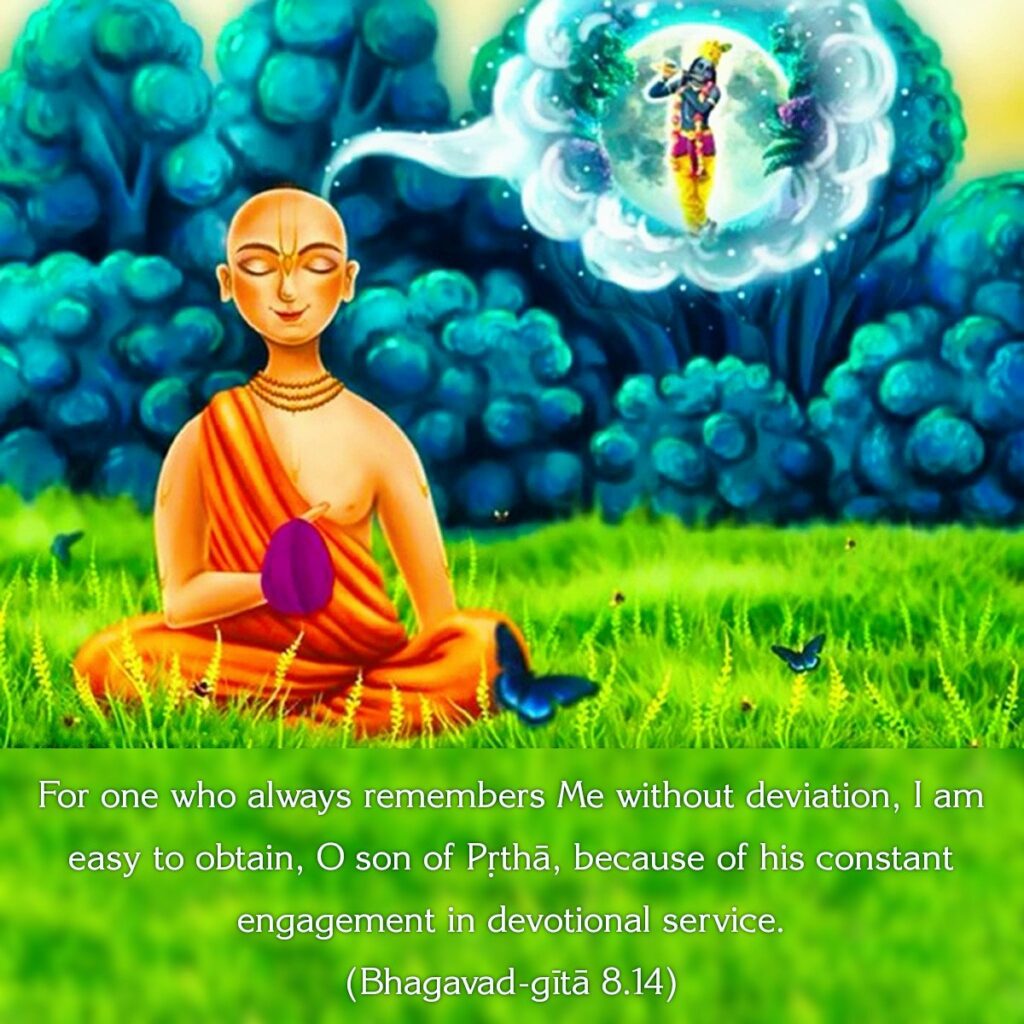
अनन्यचेता: सततं यो मां स्मरति नित्यश: |
तस्याहं सुलभ: पार्थ नित्ययुक्तस्य योगिन: || 14||
ananya-chetāḥ satataṁ yo māṁ smarati nityaśhaḥ
tasyāhaṁ sulabhaḥ pārtha nitya-yuktasya yoginaḥ
ananya-chetāḥ—without deviation of the mind; satatam—always; yaḥ—who; mām—Me; smarati—remembers; nityaśhaḥ—regularly; tasya—to him; aham—I; su-labhaḥ—easily attainable; pārtha—Arjun, the son of Pritha; nitya—constantly; yuktasya—engaged; yoginaḥ—of the yogis
Translation:
O Parth, for those yogis who always think of Me with exclusive devotion, I am easily attainable because of their constant absorption in Me.
Commentary:
The easy way to attain God is here explained. People think that it is very difficult to attain Him. But practising in the right way, He is easily attained. He who thinks of him continuously and always attains Him.
The mind should be free from any other thought except the thought of God. Usually, the mind is attached to various things and gets entangled in the meshes of the objective world through the senses. That is why it is said here that one should be filled to the brim with the thought of God continuously and forever. It is not enough to think of Him now and then. Always and every day the thought of God should be present in the mind. Of course, by steady practice day after day, the mind could be trained to think of God more and more. So practising, after a long time, the mind gets fixed and does not turn away from Him. Then the Lord is attained.
The seeker should be vigilant and try his best not to yield to the temptations of Maya. The wakeful and watchful man has no fear of falling away from the goal.
—–
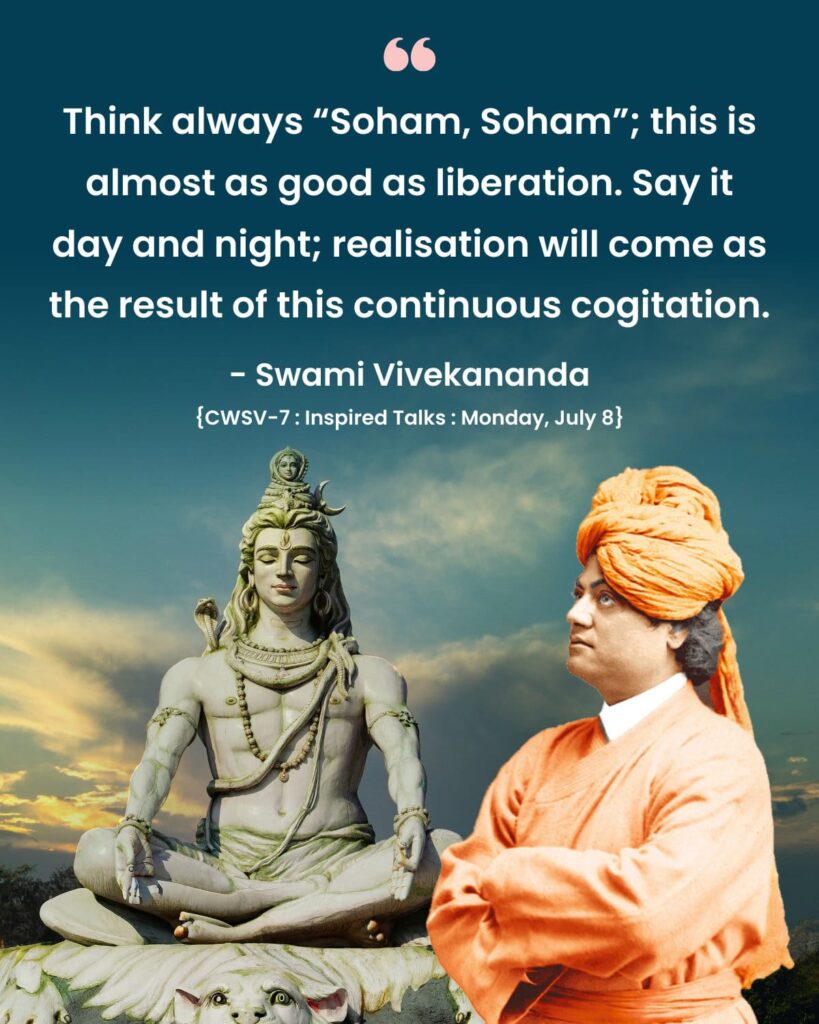
Sri Ramakrishna Says —
Sri Ramakrishna: “All are deluded by ‘woman and gold’. But I do not care for it at all. And I swear to you that I do not know anything but God.” (Source: Gospel of Sri Ramakrishna)
—–
MASTER (to the Brahmos): “Dive deep. Learn to love God. Plunge into divine love. You see, I have heard how you pray. Why do you Brahmos dwell so much on the glories of God? Is there such great need of your saying over and over again, ‘O God, You have created the sky, the great oceans, the lunar world, the solar world, and the stellar world’?
“Everybody is wonder-struck at the mere sight of a rich man’s garden house. People become speechless at the sight of the trees, the flowers, the ponds, the drawing-room, the pictures. But alas, how few are they who seek the owner of all these! Only one or two inquire after him. He who seeks God with a longing heart can see Him, talk to Him as I am talking to you. Believe my words when I say that God can be seen. But ah! To whom am I saying these words? Who will believe me?
“Can one find God in the sacred books? By reading the scriptures one may feel at the most that God exists. But God does not reveal Himself to a man unless he himself dives deep. Only after such a plunge, after the revelation of God through His grace, is one’s doubt destroyed. You may read scriptures by the thousands and recite thousands of texts; but unless you plunge into God with yearning of heart, you will not comprehend Him. By mere scholarship you may fool man, but not God.
“Scriptures and books — what can one achieve with these alone? Nothing can be realised without His grace. Strive with a longing heart for His grace. Through His grace you will see Him and He will talk to you.”
SUB-JUDGE: “Sir, does God show more grace to one than to another? If so, He can be accused of the fault of partiality.”
MASTER: “What are you saying? Do you mean to say that the moon and a glow-worm are the same, though both give light? Iswar Vidyasagar asked me the same question. He said, ‘Is it a fact, sir, that God gives more power to one and less to another?’ ‘God’, I said, ‘exists in every being as the All-pervading Spirit. He is in the ant as well as in me. But there are different manifestations of His Power in different beings. If all are the same, then why have we come here to see you, attracted by your renown? Have you grown a pair of horns? Oh, no! It is not that. You have compassion; you have scholarship; there is a greater degree of these virtues in you than in others. That is the reason you are so well known.’ Don’t you see that there are men who, single-handed, can defeat a hundred persons? Again, one man takes to his heels in fear of another; you see such a person, too. If there are not different manifestations of power in different beings, then why did people respect Keshab Sen so much?
“It is said in the Gita that if a man is respected and honoured by many, whether it be for his scholarship or his music or his oratory or anything else, then you may know for certain that he is endowed with a special divine power.“ (BG 10.41)
A BRAHMO (to the sub-judge): “Why don’t you accept what he says?”
MASTER (sharply, to the Brahmo): “What sort of man are you? To accept words without conviction! Why, that is hypocrisy! I see you are only a counterfeit.”
The Brahmo was much embarrassed. (Source: Gospel of Sri Ramakrishna)
—–
Swami Nikhilananda wrote: To her [Holy Mother], God was both Pure Spirit, or Brahman, and also the Universal Energy, or Shakti, and Sri Ramakrishna was the Divine Incarnation of modern times. “The Master is the embodiment of all deities and of all mantras,” she said. “Really and truly, one can worship through him all gods and goddesses.” And she continued: “Sri Ramakrishna assumed this human body to remove the sorrows and sufferings of others. He moved about in disguise, as a king walks through his capital. The moment he became known, he disappeared.” On another occasion Holy Mother said: “He who has prayed to the Master even once has nothing to fear. By praying to him constantly, one obtains ecstatic love through his grace. This love is the essence of spiritual life. The Master used to say to his devotees: ‘I have made the mould; now you may cast the image.’ To ‘cast the image’ means to meditate on the Master, to think of the various incidents of his life. Contemplate the great sufferings the Master had to undergo because of taking upon himself the results of the bad karma done by others, and then you will find that your body and mind have been purified. Your grief and misery will disappear if you only remember how the Master, though Divinity Itself, suffered for the sake of others and yet did not miss even for one moment the ecstatic joy he experienced from the contemplation of the Divine Mother.” Thus she advised her disciples to meditate on Sri Ramakrishna and repeat his name. Through his grace every desire of the seeker would be fulfilled. Those who pray to him, the Mother taught, “will never suffer from want of food or other physical privations, and will also easily gain love and knowledge of Brahman.” (Source: Sri Sarada Devi and Her Divine Play)
Once a devotee said to M.: “You are very fortunate. You have seen and heard Sri Ramakrishna. You have even touched him and served him.”
M. (Mahendranath Gupta) replied: “Don’t think in that way. The Master said that all his wealth and power will go to his children. Discrimination, renunciation, knowledge, devotion, and love are his wealth. These good qualities will come to the soul who thinks of him.” (Source: They Lived with God)
Just do one thing: always try to remember God. I also do that.
The easiest method of realization is to remember God constantly. Even as a man welcomes his friend, and entertains him with food, drink, and conversation, so must you entertain God in your thoughts. Converse freely with him. Know him as your very own, and you will find peace in him.
Remember God constantly. Remember him when you eat, when you sit, when you lie down; remember him whatever you do. By such repeated practice you will find that, when you go to meditate, it will be easy to remember God and become absorbed in him. As your mind becomes absorbed in meditation, a fountain of joy will spring up within you.
And Sri Ramakrishna used to say: ‘Never squander the energies of your mind.’ This means, remember God constantly. The worldly man is very careful not to squander his money, but he gives little heed to how he squanders his mind. There is nothing greater nor easier than the constant remembrance of God. Such a practice awakens the kundalini; the veils of maya are removed one after another, and a new vision opens up. Then you will see the wonderful treasure that lies hidden within you. You will unfold your own divinity.
If you work and forget God, egotism and pride will overpower you. Therefore I tell you: never forget God, no matter whether you are working or sitting idle. To maintain this attitude you must keep up your spiritual practices, no matter what happens.
— Swami Bramhananda
—–
Practice constant recollection and contemplation of God. One has to form the habit. Remember and think of Him continually, while walking, eating, lying down and even when you are actively busy. Let it be as if an undercurrent is all the time flowing. If you can practise in this manner for a while, remembrance and contemplation of Him will go on unconsciously within you; you will be repeating His name even while asleep.
What advice shall I give you? We have only one piece of advice — do not forget God. This is the essence of all teachings.
God graciously reveals Himself in the heart of a devotee who always meditates upon Him. What is needed is meditation — constant remembrance and thinking of Him. Man attains God, who is existence, knowledge and bliss absolute, by constantly thinking about the true, omnipresent, all-loving, omnipotent and all-conscious Lord. Everything is accomplished if a person succeeds in installing Him in his heart. Then special efforts at moral perfection are unnecessary. Then he spontaneously expresses qualities like truthfulness, compassion and so on.
Keep holding on to Thakur. You will get bhakti (devotion), mukti (salvation), and all. By remembering him and reflecting on him the mind and heart get purified. Apply yourself with determination. I tell you, you will get everything.
— Swami Shivananda
—–
In the beginning, you will not be able to perform meditation and Japa always — other things are necessary; a little meditation, a little Japa, some reading from the scriptures, singing devotional songs for some time — various methods to remember Him alone…
[To the question: “I am afraid you will be disgusted with me. I do not know even the Sanskrit alphabet.”] Oh, never mind. What shall you do with Sanskrit? It takes a lifetime to master it, you can use your time better. Be Mother’s child and think always of Her.
Live in the world remembering His name constantly. What else is there to do? In the world there is always good and bad, joy and suffering. We should see that we do not forget Him.
If you constantly remember that the world is unreal, what can desires do? There is no harm in fulfilling small desires, but those which make one forget the Lord are dangerous. It does not matter that you have to live in the world; if you but keep remembrance of the Lord, desires cannot lead you astray.
— Swami Turiyananda
—–
You know before a great light, lesser lights disappear; so before the effulgent glory of God, the little glory of the ego will completely vanish, as stars vanish when the sun rises. You must therefore practise the Presence of God inside you. — Swami Ramakrishnananda
—–
Even scrubbing the floor may be turned into worship if there is the remembrance of the Lord within. He looks into our hearts and judges our actions accordingly. Done sacramentally, every work is an offering to the Lord. He accepts it as He accepts a flower placed at the altar with devotion.
There is no harm if you cannot be punctual for a day or two. But you should remember Him and think of Him while engaged in work. Do it.
— Swami Saradananda
—–
Constant remembrance of God and ultimate reliance upon Him under all circumstances is Sadhana. This is the last word in one’s Sadhana. — Swami Akhandananda
Whenever you find a little leisure in the course of your daily domestic works, never forget to think of Him. Read good books which help such remembrance. — Swami Subodhananda
The supreme duty of man is to remember Him always, whether one is engaged in consciously repeating His name or not. Every breath of ours should be associated with Him, in our mind. — Swami Vijnanananda
Related Articles:
- O Arjuna! Those verily who renounce all actions in Me, think of Me as the only refuge and worship Me with single-minded devotion and Dhyana, to them I become the saviour and quickly lift them up from the ocean of death and ‘samsara’. (BG 12.6-7)
- Those persons who worship Me, meditating on their identity with Me and ever devoted to Me— to them I carry what they lack and for them I preserve what they already have. (BG 9.22)
The 6 Objects of Smarana (Focus of Remembrance)
Seekers also practice smarana by focusing on five distinct aspects of the Divine. These are often practiced sequentially, as each step purifies the heart for the next:
- Nama-smarana (Name): Remembering and chanting the holy names of the Lord. This is considered the foundation of all other forms of remembrance, as the name cleanses the mirror of the mind.
- Rupa-smarana (Form): Meditating on the beautiful, transcendental form of the Lord. Once the mind is steadied by the holy name, the divine form begins to naturally awaken in the heart.
- Guna-smarana (Qualities): Contemplating the infinite, endearing qualities of the Lord, such as His boundless compassion, wisdom, and love for His devotees.
- Parikara-smarana (Associates): Remembering the pure devotees and eternal associates of the Lord. Meditating on their mood of surrender helps the seeker cultivate that same devotion.
- Lila-smarana (Pastimes): Absorbing the mind in the eternal, joyful pastimes (lilas) of the Lord. This is considered the pinnacle of smarana, where the soul enters into a deep, loving meditation on divine activities.
- Vani smarana—the remembrance of the words, teachings, or message of the Lord and the Guru—is a profoundly important concept, often considered the very lifeblood that sustains all other forms of devotion and spiritual practice.
Question: Who can attain God easily?
Answer: Those who worship God with single-minded devotion day after day and forever attain him.
Question: What is the easy path to realise God?
Answer: (1) Single-minded devotion and (2) Constant contemplation of the Divine.
Bhagavad Gita: Chapter 8 🔻 (28 Verses)