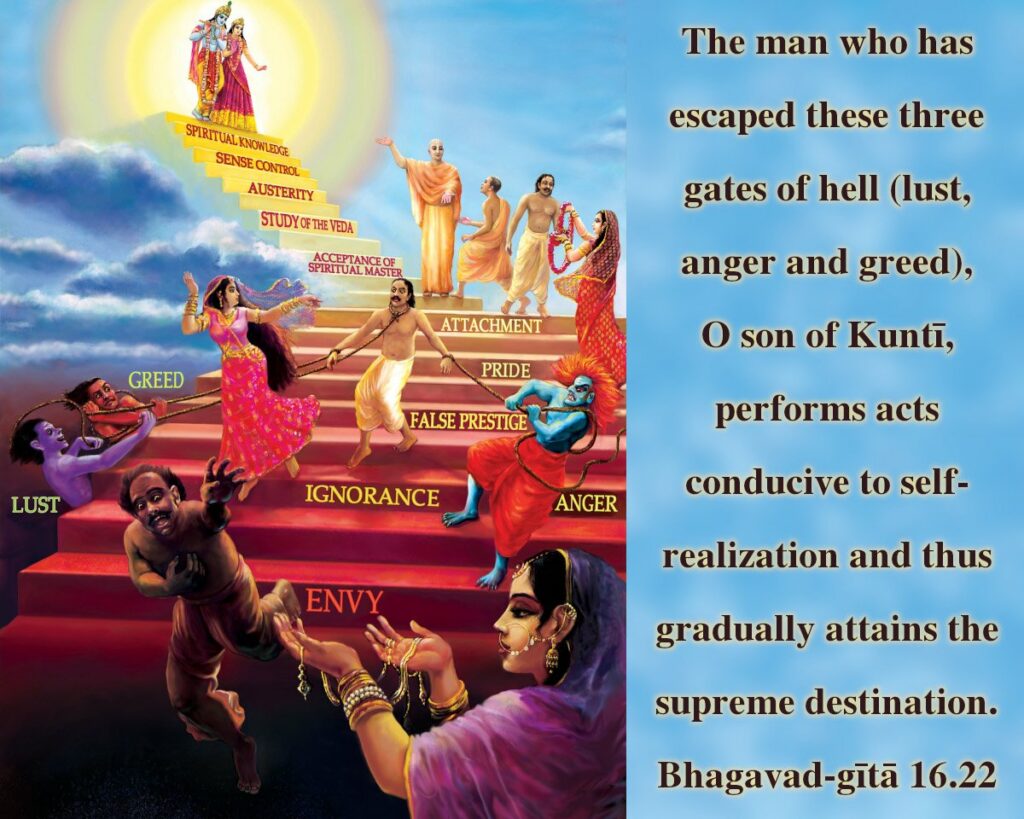
एतैर्विमुक्त: कौन्तेय तमोद्वारैस्त्रिभिर्नर: |
आचरत्यात्मन: श्रेयस्ततो याति परां गतिम् || 22||
etair vimuktaḥ kaunteya tamo-dvārais tribhir naraḥ
ācharaty ātmanaḥ śhreyas tato yāti parāṁ gatim
etaiḥ—from this; vimuktaḥ—free; kaunteya—Arjun, the son of Kunti; tamaḥ-dvāraiḥ—gates to darkness; tribhiḥ—three; naraḥ—a person; ācharati—endeavor; ātmanaḥ—soul; śhreyaḥ—welfare; tataḥ—thereby; yāti—attain; parām—supreme; gatim—goal
Translation:
The man who has escaped these three gates of darkness, Ο son of Kunti, practises what is good for himself and thus attains the Supreme Goal.
Commentary:
So long as the triple evil of desire, anger, and greed poison the heart of man, he cannot do any good. He cannot accomplish his own well-being. Therefore man should first purify his heart by reducing and eliminating these corrosive evils. Then he spontaneously rises to higher planes of spiritual life and attains Moksha. Like the sun and moon freed from the darkening grip of Rahu and Ketu, like the Gajendra freed from the death hold of the crocodile (Makara), like the prisoner brought out into the sunlight from the darkness of the prison-cell, the Jiva should liberate himself from the strange-hold of those three evils. He should become vimuktah (i.e) completely free from them. The idea is that there should not be any trace of these evils anywhere in the mind. They are the gateways of darkness (i.e) they are forms of ignorance (avidya) where there is no gleam of light, where everything is plunged in darkness. Such a man is like one living in a closed house full of darkness. He lives in sorrow and perishes in sorrow.
Acharatyatmanah sreyah: The well-being of self requires thoughtful discrimination of the real and the unreal. What is this life? What is the world? What is the end and aim of life? These questions arise in the mind of the sattvic man who is partially awakened to find out the truth. But the man who is possessed by lust, anger and greed, cannot think of these things at all, because his whole mind is absorbed in sensual cravings, is agitated by anger, and confounded by inordinate greed. So, the seeker should keep away from these evils and that is in itself the great good that man can do unto himself. For, where these evils are not, the mind is pure, and when the mind is pure, he enjoys bliss of the Self.
Param gatim: Moksha is the highest goal and there is no state higher than that. It is implied that the lowest state is that of demonical ignorance resulting in Kama and Krodha.
UNMOOR THE BOAT
Naag Mahashay was a great saint of Bengal. He was a disciple of Sri Ramakrishna. Swami Vivekananda considered him a mighty saint and has said that East Bengal had been completely purified by Naag Mahashay’s birth and presence. Naag’s father used to roll a rosary and do japa constantly. One day, the father asked Naag, “Why am I not spiritually progressing, whereas you have evolved so much?” Naag Mahashay smiled and said, “Father, once, a person was constantly rowing his boat in the Ganga, but he never reached the other shore. Do you know why? He had not yet unmoored the boat.”
This means that unless you are free of the inner troubles of lust, anger, and greed—whatever meditation and spiritual practices you may take up, however many books you may read—you will find it difficult to evolve spiritually. In fact, it is impossible. Real śreyas can happen only when one transcends these negative tendencies.
One ought to live one’s daily life per the Vedic injunctions. Whatever the śāstras say is pramāṇa; disobeying them is pramāda—inadvertence, heedlessness. One may enjoy the world’s pleasures, provided it is in accordance with the śāstras. Such enjoyment will not cause harm. They are considered dharma. However, if one lives according to one’s own whims and fancies, that is called adharma. That will lead to annihilation. This is what Bhagavan speaks about in the next verse. (Source: Srimad Bhagavad Gita – Elixir of Eternal Wisdom | Vol 3)
Question: Where do the triple evils of lust anger and greed lead to?
Answer: To Hell. They are the gateways to darkness.
Question: Who aspires for Moksha?
Answer: The man who is freed from these three evils.
Question: What is Moksha?
Answer: It is the perfect state of freedom from all kinds of bondage.
Bhagavad Gita: Chapter 16 🔻 (24 Verses)