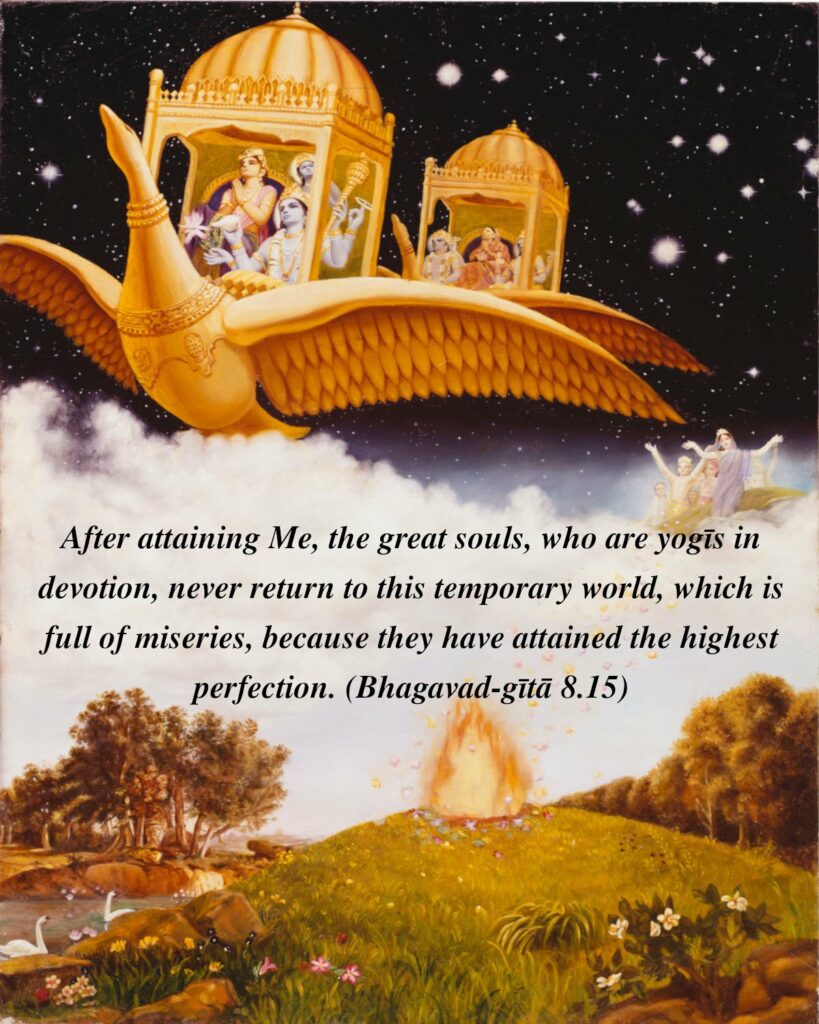
मामुपेत्य पुनर्जन्म दु:खालयमशाश्वतम् |
नाप्नुवन्ति महात्मान: संसिद्धिं परमां गता: || 15||
mām upetya punar janma duḥkhālayam aśhāśhvatam
nāpnuvanti mahātmānaḥ sansiddhiṁ paramāṁ gatāḥ
mām—Me; upetya—having attained; punaḥ—again; janma—birth; duḥkha-ālayam—place full of miseries; aśhāśhvatam—temporary; na—never; āpnuvanti—attain; mahā-ātmānaḥ—the great souls; sansiddhim—perfection; paramām—highest; gatāḥ—having achieved
Translation:
Having come to Me, these high-souled men are no more subject to rebirth, which is transitory and the abode of pain; for they have reached the highest perfection.
Commentary:
It is declared here that those who attained God do not enter samsara. So long as realisation does not come to man he is whirled about in the flood of birth and death. When the truth is known there is no birth, and hence no pain or sorrow. The need for perfect freedom is stated here. Freedom is to be attained for the purpose of transcending pain and sorrow.
The Lord makes it clear that the place where man takes birth is the abode of sorrow and is non-eternal. Birth is subject to those two evils. Even if a person feels that he is enjoying something here it is only a shadowy joy, which is mixed with pain. We see that joy is inevitably followed by sorrow as its own shadow. That is why wise men are not tempted by these reflected pleasures. The world is the abode of sorrow. It is the place where sorrow rules. Out of ignorance and delusion, man imagines that he is enjoying this or that pleasure. But the Lord who knows the truth warns mankind out of infinite compassion – “O ye mortals, do not be deluded, this world is the very abode of pain and sorrow. Seek for that which is true joy and eternal and transcend all sorrow.
‘Avidya‘ is the power which deludes man to think of non-eternal as eternal, the impure as pure, and anatma as Atma.
So the way to transcend is to attain God. Let everyone take refuge in God in every way, through devotion, knowledge, and dispassion.
Union with God is the highest state of freedom and perfection. As many enlightened sages have attained that state, it is suggested that every man can achieve it with adequate will and discrimination. Those who take refuge in God with a pure heart are mahatmas. Those who are entangled in worldly objects are ‘alpatmas,’ – little-minded men. Mahatma is a title. To reject the false and hold on to Truth, to reject the ephemeral and hold on to the Eternal, to reject anatma and hold on to Atma, is the way to attain the highest state of Mahatma. Such enlightened sages do not return to the world which is characterised by pain and sorrow. Those who are desirous of eternal joy should strive with faith and devotion to reach that state.
—–
—–
Sri Ramakrishna Says —
In the room was Hari, a young man about twenty years of age, who was a relative of the Mukherjis and very much devoted to the Master. He was married. At that time he was living with the Mukherjis and looking for a job.
MASTER (to Hari, in an ecstatic mood): “Take your initiation after getting your mother’s permission. (To Priya, referring to Hari) I couldn’t give him the mantra though I said I would initiate him. I don’t initiate people. Continue with your own meditation and japa as you have been doing.”
PRIYA: “Yes, sir.”
MASTER: “And I am saying this to you in this state of my mind. Believe my words. You see, there is no show or deceit here. I just said to the Divine Mother in my ecstatic mood, ‘O Mother, may those who come here [referring to himself] through sincere attraction obtain perfection!'” (Source: Gospel of Sri Ramakrishna)
—–
MASTER (to Hazra): “Love of God, when it is intense and spontaneous, is called raga-bhakti. Vaidhi-bhakti, formal devotion, depends on scriptural injunctions. It comes and it goes. But raga-bhakti is like a stone emblem of Siva that has sprung up out of the bowels of the earth. One cannot find its root; they say the root goes as far as Benares. Only an Incarnation of God and His companions attain raga-bhakti.”
HAZRA: “Ah me!”
MASTER: “One day I was returning from the pine-grove, when I saw you telling your beads. I said to the Divine Mother: ‘Mother, what a small-minded fellow he is! He lives here and still he practises japa with a rosary! Whoever comes here [referring to himself] will have his spiritual consciousness awakened all at once; he won’t have to bother much about japa. Go to Calcutta and you will find thousands telling their beads — even the prostitutes.’ (Source: Gospel of Sri Ramakrishna)
Question: What is the nature of this world?
Answer: It is full of sorrow and non-eternal.
Question: Who do not enter the world?
Answer: Those who have attained God.
Question: What is that God-state?
Answer: It is the state of highest perfection.
Question: What is the way to transcend sorrow?
Answer: Not to enter the world (take birth) is the way to transcend sorrow.
Question: What is the way to become birthless?
Answer: Attaining the highest perfection-Paramatma.
Bhagavad Gita: Chapter 8 🔻 (28 Verses)