On the evening of Saturday, December 23rd, Swamiji along with Professor Baumgardt, Miss Macleod, and Alice, went to watch a play at the Los Angeles Theatre on the city’s Broadway. This was no ordinary play. The central theme of this play, in the genre of a farce, was lionising of a celebrated Indian monk by New York’s high society – doubtless modelled on Swamiji’s earlier stay in New York during his first visit. The play had successfully opened in New York in 1896, exactly around the time Swamiji was there and had also run in other parts of America as well as in England. Alice recounted that the “play was really very funny, and Swamiji enjoyed it hugely. Professor Baumgardt said he had never seen anyone laugh so hard or so much as Swamiji did.”
Swamiji had also gone to watch a vaudeville, which was then the most popular form of entertainment in the United States – shows that consisted of a variety of short unrelated performances by singers, dancers, acrobats, jugglers, dramatic artists, and magicians. What brought this about was the personal invitation of a 16-year old girl who was a performer in the vaudeville. The girl and her mother had attended Swamiji’s lectures in London three years back and had had a deep impress upon their minds. Such an affectionate invitation Swamiji could not decline.
After the discontinuation of the practical Raja-Yoga lectures in the second week of January, Swamiji was left with some more spare time which his earlier packed engagements of classes and lectures hardly gave. Hence oc account of affectionate persuasions by Miss Macleod and her elder sister Betty Leggett, Swamiji went on a couple of excursions around Los Angeles area.
The first one, on 13th January, was to Mount Lowe, originally called Oak Mountain, a 5600 feet summit on the southern fold of the mountainous range of San Gabriel, about seventy miles north-east of Los Angeles. The peak was renamed after Professor Thaddeus S.C. Lowe, who was the first person to set foot on the peak and plant the American flag there. He was instrumental in building the Mount Lowe Railway in 1896, hailed as a great engineering marvel of the time, considering the challenging incline it had to negotiate.
The man after whom the peak was named and who had resolved to take the railway up the peak was himself a fascinatingly accomplished man, and it would not be out of place to speak about him in some detail here. Thaddeus Lowe (1832-1913), was an American Civil War aeronaut, scientist and inventor, who had largely been an autodidact, tutoring himself in the fields of chemistry, meteorology, and aeronautics, and a pioneer of military aerial reconnaissance in the United States. In July 1861, i.e. during the American Civil War, Lowe was appointed Chief Aeronaut of the Union Army Balloon Corps by President Lincoln.
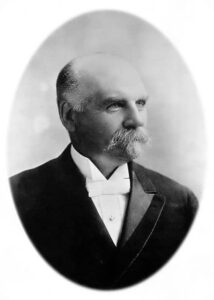
He is most famous for the Lowe’s process, named after him, which is a method he designed in 1873, by which large amounts of hydrogen gas could be produced from steam and coke for residential and commercial use in heating and lighting. This gas provided a more efficient heating fuel than the common coal gas, or coke gas, which was then used in municipal service. He was also able to run successful businesses in cold storage, as well as products which operated on hydrogen gas. These patents and ice-making machines made him a millionaire and subsequently he relocated to Southern California, building himself a mansion in Pasadena. He opened several ice-making plants and founded Citizen’s Bank of Los Angeles.
While Professor Lowe was in Pasadena he joined hands with David J. Macpherson, a Canadian civil engineer, specialising in railway engineering, and their common dream of taking rail up the San Gabriel range led to the incorporation of the Pasadena & Mount Wilson Railroad Company in 1891. The railway opened on 4th July 1893, the day of Declaration of American independence.
It was on this funicular railway which originated from the foothills, a day after his 37th birthday, that Swamiji with his friends – Professor and Mrs. Baumgardt, Mrs. Leggett and Miss MacLeod travelled. They were brought to the hotel, the celebrated Echo Mountain House, also built by Professor Lowe. The hotel was a fine property and had seventy rooms.
It is interesting to know that Swamiji was one of the last few visitors to the hotel as just three weeks after his stay it got burned down in a kitchen fire. The smoke of the burning hotel could be seen from Pasadena for many hours, serving as a spectacle for residents of Pasadena, and became a major news point of the time.
The Mount Lowe Observatory had a huge telescope, not a common thing then, and it is certain that Swamiji and his friends had a view of the stars from there. They spent the night at hotel. The hotel took the advantage of the presence of its illustrious guest and arranged for him to deliver a talk in the morning. After the lecture, Swamiji and his party, boarded a small trolley car which took them up the mountains. The three and half mile ride offered beautiful views of canyons and ravines and brought them to Alpine Tavern. Another mile from the Tavern was the summit of Mount Lowe.
The Mount Lowe remained a much visited location and still features in the National Register of Historical Places.
After the excursion to Mount Lowe Swamiji went on a trip to Redlands on 16th January, accompanied again by Miss MacLeod and Mrs. Leggett. It was a day visit only and he returned to Pasadena to deliver a lecture in the evening. Redlands, a small town some seventy miles east of downtown Los Angeles, was a much visited place in Southern California during that time. The Swami’s group had lunch at the grand and famous Casa Loma Hotel, which was an important social and cultural centre in Redland having the distinction of being visited by several American Presidents. The group also visited the Canyon Crest Park, considered to be a horticultural splendour.
The Swami found the atmosphere in Los Angeles to be very India-like and remarked that it was very ‘restful’.
In a letter to Mary Hale of Chicago dated 27th December 1899, when he was still at Mrs. Blodgett’s place, he had written about the winter in Southern California:
“It is exactly like Northern Indian winter here, only some days a little warmer; the roses are here and the beautiful palms.”
▶Next Chapter: Work begins in Pasadena