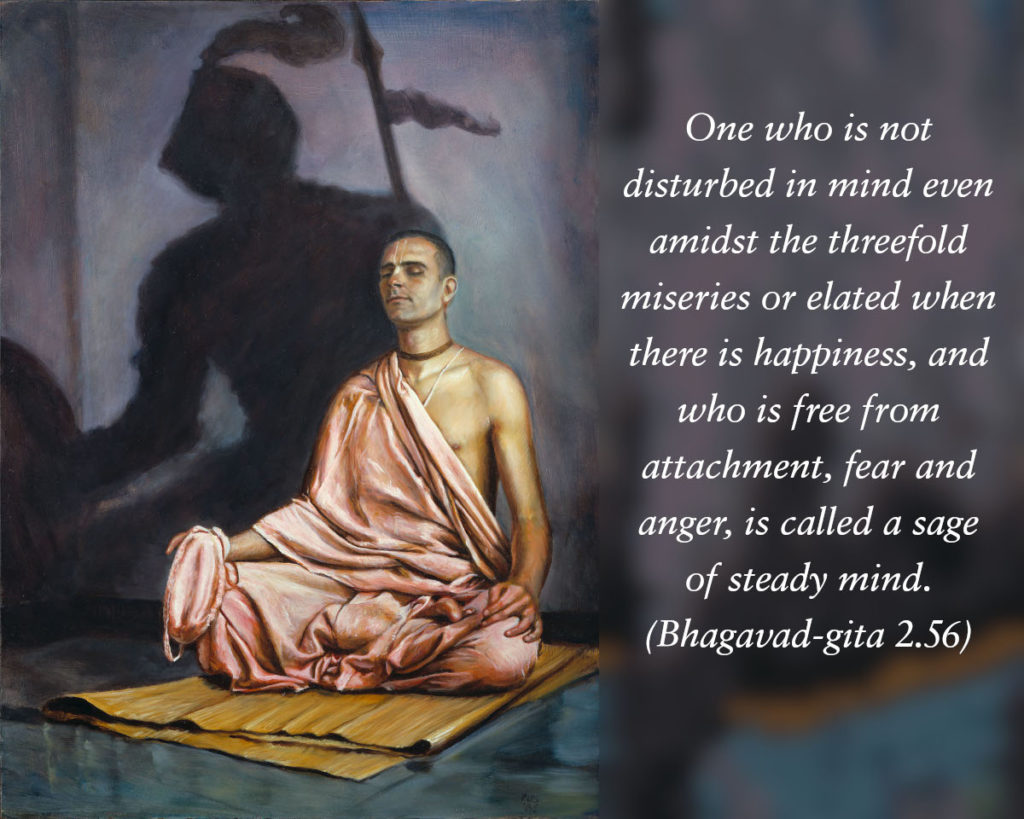
दु:खेष्वनुद्विग्नमना: सुखेषु विगतस्पृह: |
वीतरागभयक्रोध: स्थितधीर्मुनिरुच्यते || 56||
duḥkheṣhv-anudvigna-manāḥ sukheṣhu vigata-spṛihaḥ
vīta-rāga-bhaya-krodhaḥ sthita-dhīr munir uchyate
duḥkheṣhu—amidst miseries; anudvigna-manāḥ—one whose mind is undisturbed; sukheṣhu—in pleasure; vigata-spṛihaḥ—without craving; vīta—free from; rāga—attachment; bhaya—fear; krodhaḥ—anger; sthita-dhīḥ—enlightened person; muniḥ—a sage; uchyate—is called
Translation:
He whose mind is not troubled in sorrow, who does not hanker after pleasures and is free from attachment fear and hatred, is called the sage of steady wisdom.
Commentary:
The characteristics of sthitaprajna are further elaborated here.
Mind not troubled in sorrow: The mind of the sthitaprajna is not troubled by the sorrows. disasters and calamities of life. The sun who is far above the storm clouds is not affected by thunder, lightning, and rain. In the same way, pain and pleasure are the natural reactions of the mind to external phenomenon, and Atma being above the mind (i.e.) transcending the mind, is not affected by its modifications. It remains as the witness of the mind, in the same way, as the Sun is just the witness of what is happening in the lower region of the earth. Vasishta explains to Sri Rama that just as arrows cannot powder a mountain, just as the sea-waves cannot move the mountain on the shore, just as the lotus creeper cannot bind an elephant, even so the sorrows and troubles of the world cannot affect the Jivanmukta, the sthitaprajna.
Who does not hanker after pleasures: The Stitaprajna does not hanker after the pleasures of the body and the senses. He is not thrown off his Self-state when pleasant and delighted things come to him. Pain and pleasure are just two different waves of the mind. One wave is called pleasure and another is called pain. Both are caused by the contact of the mind with external objects. If the object is agreeable, there is a wave of pleasure. If the object is undesirable, there is a wave of pain. The sthitaprajna whose mind is firmly established in Atma is not moved one way or the other when pleasant and unpleasant things occur. The Jivanmukta has found himself one with the ocean of bliss, and as such how can he think of attaching himself to any kind of material pleasure? He knows that these little pleasures are only ripples on the surface of the ocean of bliss and that they are shadowy reflections of his own Self. No one can cling to the pleasures of a dream when he awakens from the dream. If really he desires such pleasures, it only shows that he has not yet fully awakened from the dream. So also, he who clings to worldly pleasures arising from the senses and sense objects is not a Sthitaprajna. Attachment to people, places, and objects takes away the intellect. People are helplessly tied with the rope of attachment. One has to learn to cut this rope with the sword of knowledge of the Absolute and become detached and free. We have the shining example of Suka, as the Sthitaprajna par excellence. If today we come across a man of such caliber who can look upon pain and pleasure with an equal eye, verily we have to honor him as a Jivanmukta.
Free from attachment, fear, and hatred: Again, it is pointed out that the Sthitaprajna is free from attachment, fear, and hatred. To the man of knowledge, everything appears as Atma, in the same way as everything appears as material objects to the ignorant man. What then can he desire? Whom can he fear or hate? The same truth is declared in the Esavasya Upanishad also.
For the wise man who knows that everything is that one Atma, there can be no delusion and no sorrow. He has realised that all that exists is only the Supreme Self and nothing else. Fear and hatred arise only when there is a second thing. When all this is one indivisible Satchidananda Absolute, where is fear and where is hate? He is himself everything. Can he hate himself? Can he fear himself? No. That is the state of the Jivanmukta, the Sthitaprajna – supreme and transcendental.
Munih: The sage who is engaged in speechless absorption in the Self is a Muni. Only such a strong-willed man of action can ascend the peak of the Soham (I am he), mount. The idle and the lethargic have no chance of winning the goal. The sage who has acquired one-pointed concentration in the Self is Sthitaprajna.
Swami Vivekananda Says —
Arjuna asks: “Who is a person of established will?” [Krishna answers:] “The man who has given up all desires, who desires nothing, not even this life, nor freedom, nor gods, nor work, nor anything. When he has become perfectly satisfied, he has no more cravings.” He has seen the glory of the Self and has found that the world, and the gods, and heaven are … within his own Self. Then the gods become no gods; death becomes no death; life becomes no life. Everything has changed. “A man is said to be [illumined] if his will has become firm, if his mind is not disturbed by misery, if he does not desire any happiness, if he is free of all [attachment], of all fear, of all anger.[Source]
Vivekananda returned unexpectedly to Belur on 9 December 1900; after his second visit to the West he was not well. Owing partly to this and partly to the fact that he wanted to see the work progress as quickly as possible during his lifetime, he was now and then very severe in his dealings with brother disciples. During this time no one dared go near Swamiji except Saradananda, whose steadiness and mental poise could freeze anybody’s hot temper. Once Swamiji sent Saradananda to Calcutta on an errand. When he learned that it had not been done, he rebuked him with harsh language. Saradananda remained as motionless as a statue. When tea was served, he began to drink it as if nothing had happened. Disappointed, Swamiji commented: “Sharat’s veins carry the blood of fish; it will never warm up.” Observing that Saradananda was free from anger, Swamiji teased him at other times, “Your veins carry frog’s blood, or the blood of sand fish.” Swamiji knew that this noble evenmindedness is necessary for the head of a monastic order.(Source: God Lived with Them)
—-
“In his dealings with us younger monks,” writes Swami Aseshananda, “Swami Saradananda’s love and forgiveness were limitless. One day when I was with him at Puri, he told me he couldn’t find the beads that he usually kept in a drawer. ‘They belonged to the Holy Mother and I kept them after her mahasamadhi,’ he said. ‘They were strung on a golden thread. Probably somebody came and took them on account of the golden thread while we were away seeing Lord Jagannath at His temple.’ I was concerned. I thought perhaps I had accidentally thrown the rosary into the sea along with the flowers after evening worship. I returned to the beach and searched for a long time but found nothing. The swami consoled me: ‘One by one everything is going away. This is the will of the Mother. What can be done? Don’t worry.’” (Source: God Lived with Them)
—–
“Service to man is service to God.” This message of Vivekananda was exemplified in Saradananda’s life. He acted as the mother of the Order. Whenever Holy Mother or any of the direct disciples were sick, he was always present to look after their treatment. Once when Brahmananda was living in Belur Math he was suffering from an abscess and needed minor surgery. Saradananda accompanied Dr. Kanjilal (a devotee and disciple of Holy Mother) from Calcutta, and they left for the monastery by boat. In the middle of the Ganges, a heavy storm arose and the country boat began tossing violently. Saradananda was calmly smoking his hubble-bubble, but the panicky doctor could not control himself. Angrily he threw the hubble-bubble into the Ganges, and told Saradananda: “You are a strange man! The boat is about to sink, and you are enjoying your smoke!” The swami calmly said, “Is it wise to jump into the water before the boat sinks?” He then advised the boatman to put the sail down. Gradually the storm subsided and the boat safely reached the Belur ghat. This incident indicates that the knower of Brahman conquers the fear of death, and that nothing in this world can perturb him. (Source: God Lived with Them)
THE SAGE AND THE ANGRY MOB
When Gandhiji was assassinated, riots broke out all over India. Rumours spread like wildfire, igniting hatred. One such rumour was that it was a Muslim who had shot Gandhiji. This resulted in communal riots in the Hindu-Muslim communities. Riots broke out in Tiruvannamalai also, and the situation was very tense. At that time, in Sri Ramanasramam, Bhagavan Ramana was reclining on a couch outside the hall, facing Arunachala, the Sacred Hill, and reading a book or a letter. Many devotees were seated around him.
THE SAGE KNOWS THAT HE IS NOT THE MIND. HE EVER ABIDES IN THE SELF AND NOT IN THE MIND.
Suddenly, the angry cries of a mob were heard. Soon, about a hundred people chasing another hundred, armed with knives, sticks and stones, rushed into the ashram through the back gate, close to where the Maharshi and the devotees were seated. Seeing this, most of the devotees assembled there ran helter-skelter in fear. Amid all this commotion, the Sage sat motionless like a painted picture. He did not even lift his head to see what the fuss was. He just sat most naturally as if nothing was happening, even when the raging mob rushed past on either side, screaming and shouting. There was not even a blink in his eyes; there was no recognition of anything happening. This is abhayam—fearlessness.
When the Self is recognised, and the truth that nothing exists other than the Self is known, there remains nothing to be attached to, nothing to fear, and no one to be angry with. For us to become angry, there must be another. When we see others as our own Self, the Atman, how can we be mad at them? When we know everyone is the Self, whom will we be angry with? No krodha is possible. Anger is erased when the same Self is beheld everywhere. Sankaracharya says,* “In you, in me, and in all—in everyone, everywhere—there is only one Vishnu. You are getting angry unnecessarily.” Emotions such as anger arise only when an ‘other’ is seen. When everyone is known to be the Self, there is no room for rāga, bhaya and krodha.
The only solution for all miseries is to know the one truth that the Atman alone exists. Whether it is pleasure or pain, there is no rising of any forceful emotions in the Sage. It is not that the mind of a Sage is like a stone. It too thinks and conducts all practical things as necessary. Many noble feelings might arise in him. But the difference is that the Sage knows that he is not the mind. He knows that he is the sākshi, the witness-principle. Hence, he ever abides in the Self and not in the mind. Thus there is no longer any sorrow. When the delusion of the other is gone, there is no room for any misery.† Steady abidance in one’s real nature is indicated by the word sthitadhīḥ. (Source: Srimad Bhagavad Gita – Elixir of Eternal Wisdom | Vol 1)
EQUANIMITY OF SUDAMA
The story of Sudama from the Bhagavata is a perfect example of anudvigna-manāḥ. Sudama lived a life of such utter poverty that often there was no food, even for a single meal. He was peaceful even under such miserable conditions. “He was a praśāntātmā,” says the Bhagavata. He was so because he was a “brahma-vittamaḥ”—Supreme Knower of Brahman. We know that later when he met his friend Krishna, the gracious Lord made him very prosperous. The Bhagavata says that in a trice, his life was transformed miraculously from one of utter penury to that of great abundance. But, then too, Sudama remained perfectly poised and indifferent, ever established in Brahman. Thus, we can see that the Lord’s māyā failed to win over him in both these situations. “Faced with the equanimity of this desireless Brāhmaṇa,” says the Bhagavata, “the unconquerable Lord had to accept defeat—ajitaṃ parājitam!” The Lord’s compassion appeared rather insignificant in comparison to the stability of this Brāhmaṇa. (Source: Srimad Bhagavad Gita – Elixir of Eternal Wisdom | Vol 1)
Question: What further qualities of the sthitaprajna are mentioned here?
Answer: He is not distressed by sorrow, does not hanker after pleasure, is free from attachment, fear and hatred.