नियतं कुरु कर्म त्वं कर्म ज्यायो ह्यकर्मण: |
शरीरयात्रापि च ते न प्रसिद्ध्येदकर्मण: || 8||
niyataṁ kuru karma tvaṁ karma jyāyo hyakarmaṇaḥ
śharīra-yātrāpi cha te na prasiddhyed akarmaṇaḥ
niyatam—constantly; kuru—perform; karma—Vedic duties; tvam—you; karma—action; jyāyaḥ—superior; hi—certainly; akarmaṇaḥ—than inaction; śharīra—bodily; yātrā—maintenance; api—even; cha—and; te—your; na prasiddhyet—would not be possible; akarmaṇaḥ—inaction
Translation:
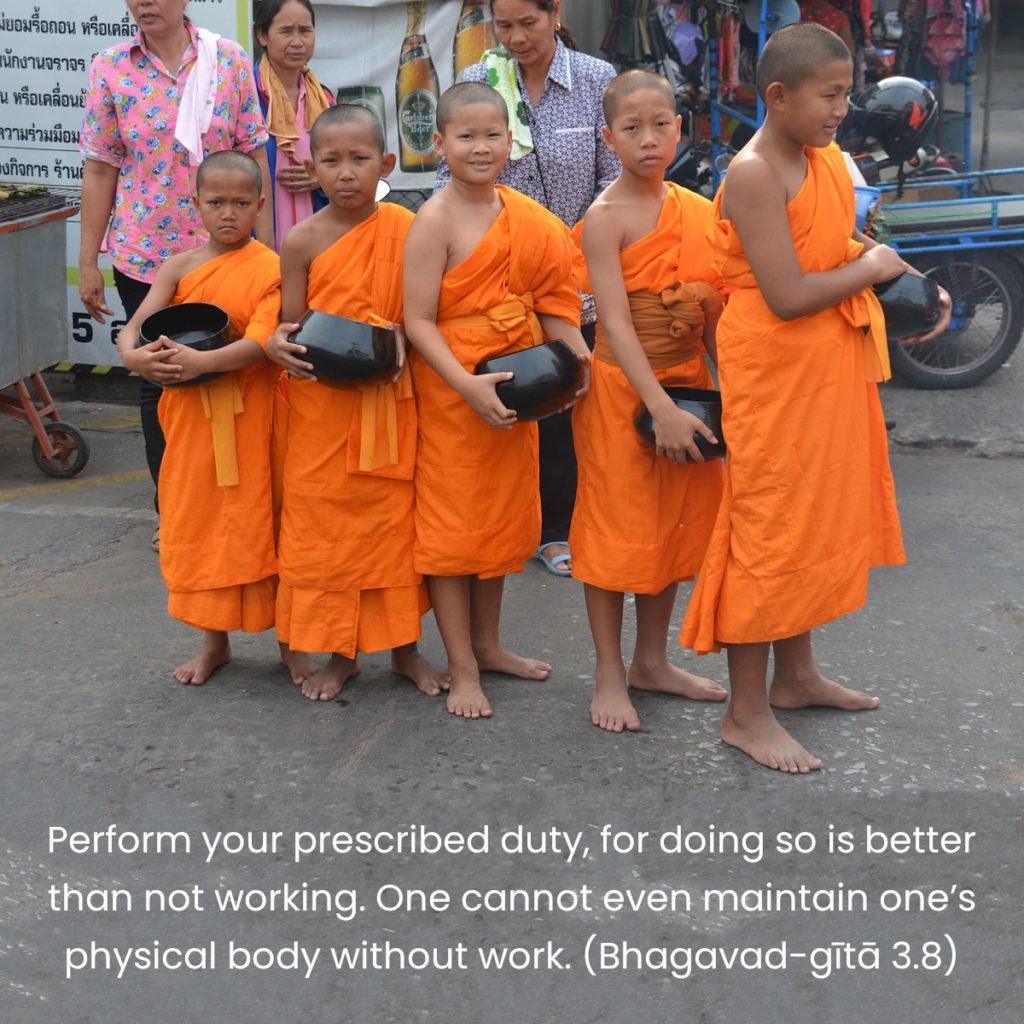
Doing the work prescribed by the Sastras is superior to inaction. By inaction, even maintenance of the body for you would not be possible
Commentary:
Do the work prescribed by the Sastras: This is the Lord’s direct answer to Arjuna’s appeal-tell me decisively one path (tadekam vada nishehitya) (3-2).
The work prescribed by the Sastras should be performed. By it, the mind becomes purified and the Self is realised in the end. Nothing comes from inaction. Work certainly is superior to inaction. By inaction, even bodily existence is impossible. The Lord commands Arjuna to be up and active in the performance of his duty.
It is befitting the universality of the Gita to give to this word karma a larger interpretation than the mere performance of ritual. Man is continuously acting in various fields of personal, social, and national life. He is at work in the house, in the office or factory, in the co-operation endeavour of national projects. All this is karma. The Lord’s observation that even physical existence becomes impossible by inaction, should be understood as a call to the nation to work and work hard for its own and universal benefit. The world today needs men capable of and dedicated to work. Each one in his own field has to do work and more work as much as possible for him to do.
SANT TUKARAM — WORK AND SPIRITUALITY
Saints like Tukaram, Namadev and Kabir were householders. They worked until their end and performed their duties beautifully. They never begged for their livelihood. “If you beg for your livelihood, you will be forsaken by Narayana,” sings Tukaram. This was their attitude.
Tukaram was a grocery merchant. The pure saint that he was, he lacked the clever knack needed to succeed in business. He would give away his grocery items free of cost to the poor and thus incur great losses. Once a rich man, he soon became penniless and faced many difficulties. His wife became quite annoyed with his ways and would scold him often, although she loved him very much. Even with all these problems, Tukaram refrained from outward renunciation. ‘I am a vaiśya, and I must do my duty’ was his attitude. Even in utter poverty, he remained bubbling with ecstasy, chanting the nāma of Lord Vittala. Often, he went into the seclusion of Brahmagiri Hill, read the Bhagavata and the Gita, and meditated. Thus he charged himself with spiritual power to resist the mental storms and despondencies that destiny brought in. “Let the lips continue to chant the nāma ‘Ramakrishna Hari’ while the body works in the world. Then, moksha is assured like a gooseberry in your palm,” sang the saint.* Tukaram lived a simple life as a householder and worked as a grocery merchant, but his body got transformed, and each cell was charged with divinity. It is said that every fibre of his body chanted the nāma—the name of the Lord. (Source: Srimad Bhagavad Gita – Elixir of Eternal Wisdom | Vol 1)
Question: What is superior? Work or inaction?
Answer: Work is superior.
Question: What type of work?
Answer: Work prescribed by the Sastras.
Question: What harm would be caused by inaction?
Answer: Without work, the mind cannot be purified, and self-realisation is not possible. Even physical existence becomes impossible by inaction.