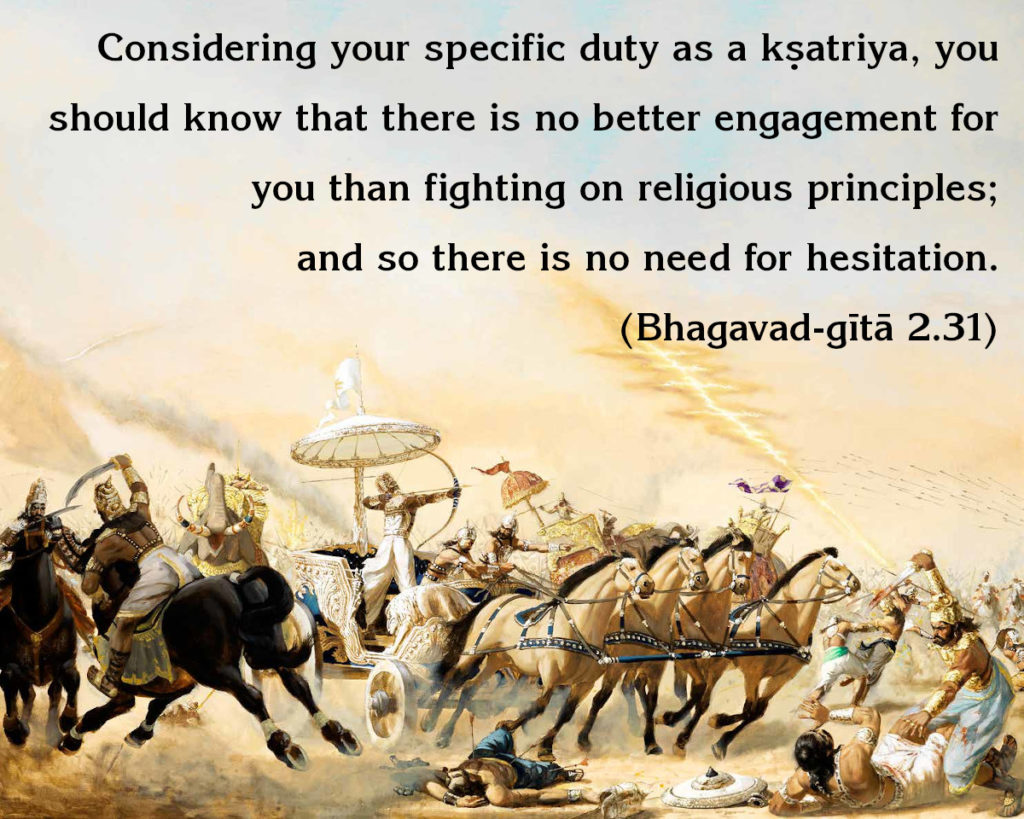
स्वधर्ममपि चावेक्ष्य न विकम्पितुमर्हसि |
धर्म्याद्धि युद्धाच्छ्रेयोऽन्यत्क्षत्रियस्य न विद्यते || 31||
swa-dharmam api chāvekṣhya na vikampitum arhasi
dharmyāddhi yuddhāch chhreyo ’nyat kṣhatriyasya na vidyate
swa-dharmam—one’s duty in accordance with the Vedas; api—also; cha—and; avekṣhya—considering; na—not; vikampitum—to waver; arhasi—should; dharmyāt—for righteousness; hi—indeed; yuddhāt—than fighting; śhreyaḥ—better; anyat—another; kṣhatriyasya—of a warrior; na—not; vidyate—exists
Translation:
And moreover, considering your own duty, you should not waver, for, there is nothing higher for a Kshatriya than a righteous war.
Commentary:
We understand from this verse how much the Lord loves the performance of one’s own Dharma. One should not waver in discharging his duty. This is the Lord’s command. So long as the body lasts, every being has to do some work or other. This is the inescapable law of our nature. Action being inevitable in the material world, it is necessary for man to do some selfless work, according to his duty, which leads to great good on the physical plane and elsewhere. More so, selfless work purifies the mind and leads ultimately to liberation. It is the duty of a Kshatriya to fight a righteous war. The Lord emphasizes the righteousness of the undertaking. Otherwise, it would be an unrighteous war resulting only in hatred, sorrow, and death, and no merit comes to anyone.
Swami Vivekananda Says —
But if you say that killing all these people is sinful, then consider this from the standpoint of your own caste-duty.[Source]
FREEDOM MOVEMENT — A SPIRITUAL PRACTICE
Gandhiji was one of the greatest proponents of non-violence. But the mystery is that he was certainly a great warrior too; he fought the war of independence in a unique way. It was indeed his way to spiritual freedom. It is true that he did Rāma-nāma japa, undertook frequent fasting, followed strict disciplines in food intake, kept vows of silence and resorted to many other spiritual practices, but these were all only preparatory sādhanās. The real sādhanā was the freedom movement that he unleashed. About this, Gandhiji himself has revealed that he found himself swept off by the river of destiny.
He did not run away to the forest to find Self-Realisation. He has said, “This entire freedom movement is only meant as a spiritual practice for me to gain Realisation. I am not concerned whether we would attain independence or not.” Many mistook these words out of context and called him selfish. On the contrary, he was striving to be extremely selfless. Here we are not discussing whether all his actions were right or wrong. The fact remains that his life is a testimony to the unique method of successfully converting the worst situation into a spiritual practice. ‘If you cannot escape from a desert, find a way to live there’ is the message. (Source: Srimad Bhagavad Gita – Elixir of Eternal Wisdom | Vol 1)