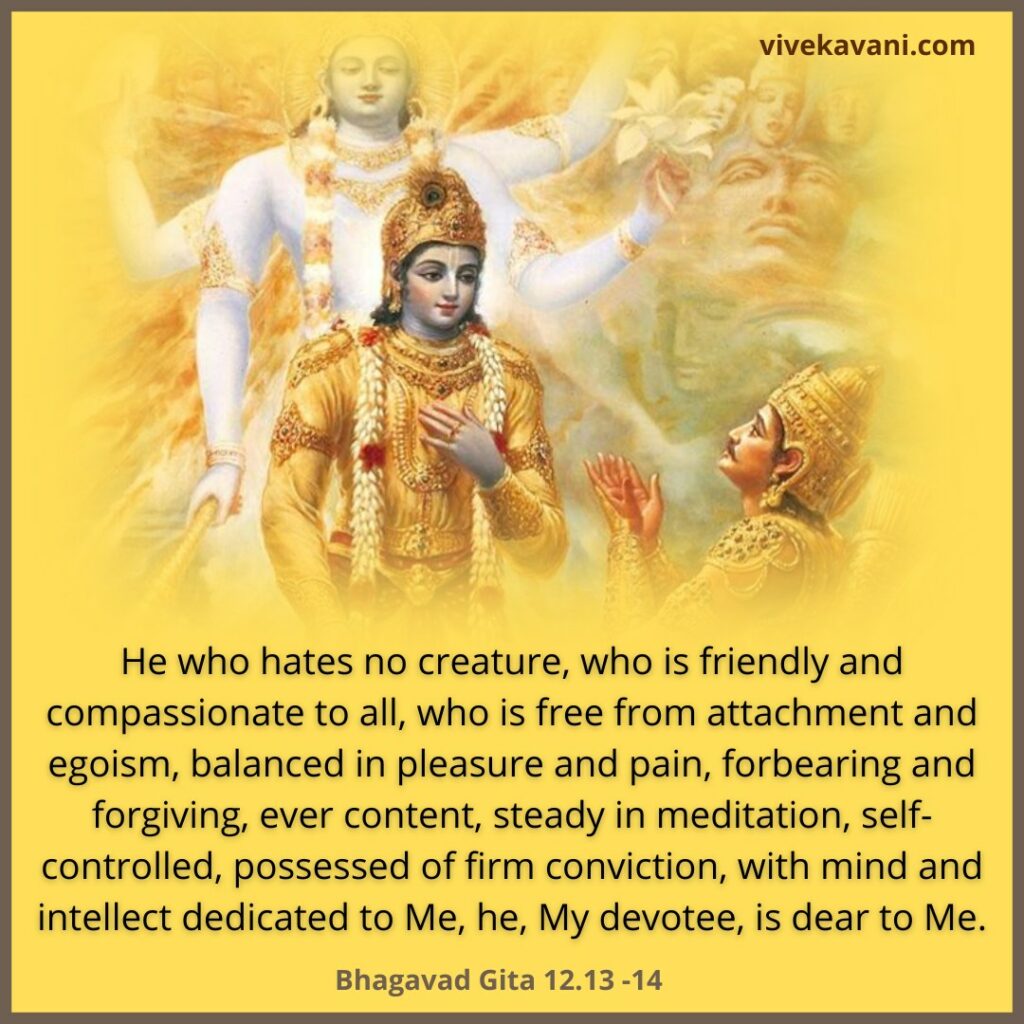
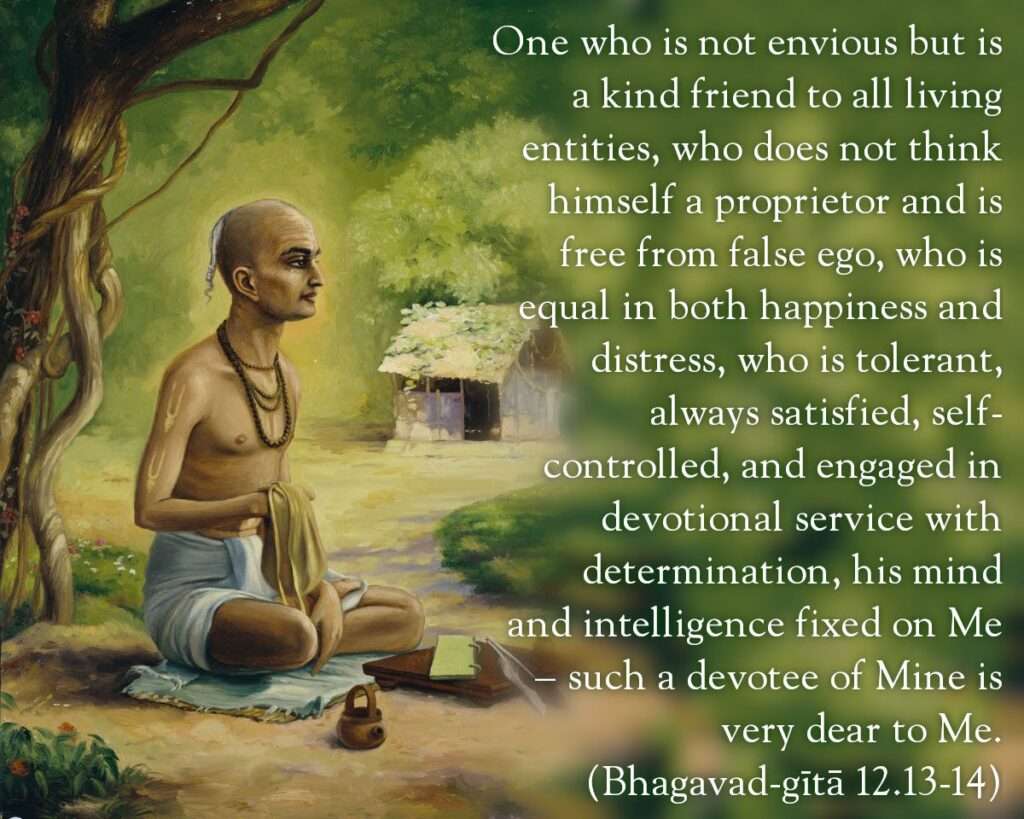
अद्वेष्टा सर्वभूतानां मैत्र: करुण एव च |
निर्ममो निरहङ्कार: समदु:खसुख: क्षमी || 13||
सन्तुष्ट: सततं योगी यतात्मा दृढनिश्चय: |
मय्यर्पितमनोबुद्धिर्यो मद्भक्त: स मे प्रिय: || 14||
adveṣhṭā sarva-bhūtānāṁ maitraḥ karuṇa eva cha
nirmamo nirahankāraḥ sama-duḥkha-sukhaḥ kṣhamī
santuṣhṭaḥ satataṁ yogī yatātmā dṛiḍha-niśhchayaḥ
mayy arpita-mano-buddhir yo mad-bhaktaḥ sa me priyaḥ
adveṣhṭā—free from malice; sarva-bhūtānām—toward all living beings; maitraḥ—friendly; karuṇaḥ—compassionate; eva—indeed; cha—and; nirmamaḥ—free from attachment to possession; nirahankāraḥ—free from egoism; sama—equipoised; duḥkha—distress; sukhaḥ—happiness; kṣhamī—forgiving; santuṣhṭaḥ—content; satatam—steadily; yogī—united in devotion; yata-ātmā—self-controlled; dṛiḍha-niśhchayaḥ—firm resolve; mayi—to me; arpita—dedicated; manaḥ—mind; buddhiḥ—intellect; yaḥ—who; mat-bhaktaḥ—My devotees; saḥ—they; me—to Me; priyaḥ—very dear
Translation:
Who does not hate any being, who is friendly and compassionate, who is free from attachment and egoism, who is equal-minded in sorrow and happiness, who is forgiving, who is always contented, steady in meditation, who is self-controlled and firm in conviction, who has surrendered his mind and intellect in Me, he (such a devotee) is dear to me.
Commentary:
In seven verses the Lord ennumerates the qualities which His devotee should possess. Thirty five virtures are mentioned and the devotee who possesses them is dear to the Lord. Each one is a subject of study, and unless the sadhaka acquires perfection in all of them, he is not supposed to have passed the test of a devotee. Let no one imagine that he can by-pass any one of them and get into the higher class! If a man desires to cross over the ocean of samsara, free himself from sorrow and misery, he should attain perfection in these virtues, and on such a man alone descends the grace of God.
God is the same to all. He does not consider anyone to be hateful or dear to Him. Those who worship Him with devotion, He is in them and they are in Him. So acquiring good qualities, the devotee becomes dear to the Lord, and the Lord confers Atmajnana on him, and by it he attains Moksha. Each one of those qualities should be cultivated assiduously by all seekers.
Many may think that they have love for the Lord. That is not enough. They should know if they are the recipients of God’s grace. They should examine themselves and find out what is standing in the way of His grace freely flowing into him. If God’s grace is obtained everything is obtained, for His grace destroys all ignorance in a flash. The Lord is perfectly clear when he declares that only those devotees are dear to Him, who possess the above-mentioned qualities (Yo madbhaktah sa me priyah).
Paramatma is the goal to be attained. The path to reach the goal is sadhana, practice. The Gita expounds more on the practical side of sadhana than the goal to be attained. So it is known as a practical guide to self-realisation. In the Second Discourse, the Lord has explained the nature and state of the man of steady wisdom (Sthitaprajna). Here the nature and qualities of the devotee are stated. In the following Discourse, He declares the qualities of the Jnani. The Daivisampath is explained, starting with ‘abhayam‘ fearlessness. In this way, the practical side of religion is frequently emphasised by the Lord in various ways.
Let the aspirant think of these qualities and make them part and parcel of his life. The first is the absence of any trace of hatred towards any creature. There is no exception to this command. Love and kind feeling toward all creatures is the basic virtue of a bhakta.
Santushtah satatam: The devotee should be fully satisfied and contented. Discontent is a sign of imperfection. Under all circumstances, the devotee should be fully at rest and at peace with himself and the world.
Dhrdhanischayah: Firm conviction in spiritual life is again an indispensable quality. The difficulty with most seekers is that the mind wavers in crucial moments of life. Doubt crops up about the truth as declared by the Guru and Sastras. Does God exist or not? Such doubts cut at the very root of spiritual life. Firm conviction that Self-realisation is the goal of life is the foundation for all growth and advancement. No doubts and surmises and speculations! All these are the ‘tricks’ of Avidya which somehow tries to bring down the aspirant into the world and bind him to the wheel of samsara.
Mayyarpita manobuddhih: The mind and the intellect should be absorbed in the Lord. The intellect being the deciding power, if it is not linked to the mind, the latter disintegrates with hundreds of doubts and fear. Firm decision and immovable faith are essential.
—–
—–
—–
Swami Vivekananda Says —
Now what is that good which is to be pursued? The good for him who desires moksha is one, and the good for him who wants dharma is another. This is the great truth which the Lord Shri Krishna, the revealer of the Gita, has tried therein to explain, and upon this great truth is established the varnashrama system and the doctrine of svadharma etc. of the Hindu religion. “He who has no enemy, and is friendly and compassionate towards all, who is free from the feelings of ‘me and mine’, even-minded in pain and pleasure, and forbearing” — these and other epithets of like nature are for him whose one goal in life is moksha.[Source]
The sattva prevailing, the man is inactive, he is calm, to be sure; but that inactivity is the outcome of the centralization of great powers, that calmness is the mother of tremendous energy. That highly sattvika man, that great soul, has no longer to work as we do with hands and feet — by his mere willing only, all his works are immediately accomplished to perfection. That man of predominating sattva is the Brahmin, the worshipped of all. Has he to go about from door to door, begging others to worship him? The Almighty Mother of the universe writes with Her own hand, in golden letters on his forehead, “Worship ye all, this great one, this son of Mine”, and the world reads and listens to it and humbly bows down its head before him in obedience. That man is really “He who has no enemy, and is friendly and compassionate towards all, who is free from the feelings of ‘me and mine’, even-minded in pain and pleasure, and forbearing.”[Source]
Sri Ramakrishna Says —
(To the devotees) “The feeling of ‘I’ and ‘mine’ is ignorance. People say that Rani Rasmani built the Kali temple; but nobody says it was the work of God. They say that such and such a person established the Brahmo Samaj; but nobody says it was founded through the will of God. This feeling, ‘I am the doer’, is ignorance. On the contrary, the idea, ‘O God, Thou art the Doer and I am only an instrument; Thou art the Operator and I am the machine’, is Knowledge. After attaining Knowledge a man says: ‘O God, nothing belongs to me — neither this house of worship nor this Kali temple nor this Brahmo Samaj. These are all Thine. Wife, son, and family do not belong to me. They are all Thine.’
“To love these objects, regarding them as one’s own, is maya. But to love all things is daya, compassion. To love only the members of the Brahmo Samaj or of one’s own family is maya; to love one’s own countrymen is maya. But to love the people of all countries, to love the members of all religions, is daya. Such love comes from love of God, from daya.
“Maya entangles a man and turns him away from God. But through daya one realises God. Sages like Sukadeva and Narada always cherished daya in their hearts.” (Source: Gospel of Sri Ramakrishna)
BHAGAVAN RAMANA — ‘ALWAYS BRAHMAN’
In one instance, a devotee of Bhagavan Ramana, Balarama Reddy, was being interviewed, and the interviewer asked, “What was Ramana Maharshi to you?”
Balaram Reddy responded, “For me, Bhagavan Ramana was always Brahman.”
“What do you mean by that?”
“It means I never found him in a state where he was not Brahman. He was ever centred in the real being. There was no moment when one could catch hold of the ego, the individuality, in him. Whenever you were with him, you felt you were with the Infinite.”
This is the sign of a real yogi. It is not that he is content only when things happen according to his wish. Whatever may happen around him, he remains content. Bhagavan says such a one is ever a yogi—satataṃ yogī. The bhāshyakāra says, “yogi means samāhita-cittaḥ.” His mind is quiet. It has attained. It has crossed the border of all turbulence and has become completely peaceful. Such a one is ever in the samādhi state.
सन्तुष्टस्य निरीहस्य स्वात्मारामस्य यत्सुखम्।
कुतस्तत्कामलोभेन धावतोऽर्थेहया दिशः॥ SB 7.15.16
How can a man running hither and thither, greedy for wealth and full of desire for objects of enjoyment, have the bliss of the one who is ever enraptured in the Self, actionless and ever-satisfied? (Source: Srimad Bhagavad Gita – Elixir of Eternal Wisdom | Vol 3)
maitrī-bhāva — SWAMI RAMATIRTHA IN AMERICA
Swami Ramatirtha, an illumined saint who lived during the latter part of the nineteenth century, moved about freely as a jīvanmukta in the Tehri region of the Himalayas. Some of his devotees compelled him to travel abroad to disseminate his teaching. Thus he went to Japan and then to America. He went abroad without even a single paisa on him! This is the freedom of the spirit. We cannot even conceive of such a situation now.
When he reached San Francisco and was about to disembark from the ship, an American approached him and asked, “Where are you from?”
Swami Ramatirtha said, “The whole world belongs to Rama.” (Swami used to address himself as Rama.)
Beguiled by this reply, the American asked further, “Don’t you have any luggage?”
“No! Rama carries only what he needs.” And he held up a small bag.
“Don’t you have any money?”
“Rama never carries money.”
“You must have some friends here. Where will you stay?”
With a sweet smile, Swami Ramatirtha immediately said, “You are my friend!” This American went on to become a great devotee of the sage.
This is the best example of maitrī-bhāva, the friendship of a Jñāni. When you see the Self everywhere, wherever you go, you meet friends; you meet your own Inner Being everywhere. (Source: Srimad Bhagavad Gita – Elixir of Eternal Wisdom | Vol 3)
—–
maitrī-bhāva — LORD RAMA’S EXAMPLE
Rama is a perfect example of maitrī-bhāva. When Ravana’s brother, Vibhishana, visited him unexpectedly and told him, “I am your friend,” Rama hugged and accepted him. Even when all others doubted Vibhishana’s intentions, Rama said,* “I will not forsake him. If a person comes to me and tells me, ‘I am your friend,’ I shall certainly accept him, even if there are flaws in him.” This is the noble way of the sages. (Source: Srimad Bhagavad Gita – Elixir of Eternal Wisdom | Vol 3)
Seeing behind the deed
At Ramakrishna Mission, Narendrapur, the rule of law implemented by Swami Lokeswaranandaji was the rule of love. One night as I was returning to the hostel through the vast acres of property, barely populated, I saw a man stealing jackfruits and caught him red-handed. We took away the jackfruits and kept him captive. We eagerly waited for the morning when we could present the thief before Lokeswarananda Maharaj and boast of our bravery. We secretly wished that Maharaj would hand him over to us and we could thrash him properly. When we brought the thief with all the stolen jackfruits before Maharaj, he said, “Since you have brought him to me, I should give the judgment, isn’t it? So, you please go.” We had to come out; but we decided to hide and see what Maharaj would do.
We heard him asking the thief, “Do you have a family?” “I have my wife and sons, Maharaj.” “And what is the means of your livelihood?” “Maharaj, I am a daily-wage labourer. But when there is no work available, I struggle to run the family.” At this reply, we could see a deep strain of pain on Maharaj’s face. He then asked, “What will you do with these few jackfruits?” “I will sell them and with whatever little money I get I will buy some provisions for the family.”
Maharaj stood up, and sent him off with some money along with all the jackfruits and something else which we could not make out. He also said, “Whenever you are in need, come to me. But do not steal.”
Seeing this, I walked up to Maharaj and asked, “What did you do Maharaj?” He replied, “Did you not hear that he struggles to feed his family? What suffering!” Maharaj’s expression revealed his intense sadness.
— Dr. Prashanta Giri
Connection to the story: Maharaj displayed karuṇa (compassion) and kṣhamī (forgiveness). Rather than hating the man for stealing from the Ashrama, he treated him as a friend in need, offering him a permanent open door (“Whenever you are in need, come to me”).
PAVĀHĀRI BABA REFORMS A THIEF
When Swami Vivekananda was travelling in the Himalayas, he happened to meet a luminous saint. During their conversation, Swami Vivekananda spoke about his guru Sri Ramakrishna and then enquired about the sādhu’s guru.
The sādhu asked, “Have you heard about Pavāhāri Baba of Ghazipur?”
Swamiji: “Yes, I have been with Pavāhāri Baba. He is a great sage.”
Sādhu: “Do you know any stories about Pavāhāri Baba?”
Swamiji: “Yes, I have heard this story about a thief who came to Pavāhāri Baba’s ashram while Baba was meditating and stole many things. As he started running away with the things, Baba woke up and saw him. Baba ran behind the thief taking a vessel full of food with him. In his hurry to get away, the thief dropped everything he had taken from the ashram. Baba picked them all up and continued to run behind the thief. Once he caught up with the thief, Baba made him sit down, served him the food, and gave him back all the things he had dropped. He told the thief, ‘You are Narayana. You are God Himself. Why do you fear when you see me? Everything in the ashram belongs to you alone. Please take whatever you wish. They are all yours. You need not even ask me for permission.’ The thief was awestruck to see such a saint.”
When Swamiji finished narrating this incident, the sādhu laughed and said, “Swamiji, shall I tell you what happened after that? The thief was completely transformed by the karuṇa and the lack of mine-ness in the saint.” With a smile, the sādhu added, “And here he is sitting right before you. I am that thief.” (Source: Srimad Bhagavad Gita – Elixir of Eternal Wisdom | Vol 3)
NṚSIMHA-BHARATI SWAMI — RESTFULNESS AMIDST THE CROWD
We quote this notable incident where a devotee compelled his agnostic friend to accompany him to visit the then Swami of Sringeri Mutt, who was camping in a village near Tirunelveli at that time. The friend replied, “What will I do by coming to see a monk? I do not have any faith in these swamis.” The devotee said, “You need not have faith; just come with me.” Thus compelling him, he took his friend to meet the mighty Swami, Sri Nṛsimha Bharati. As they entered the camp area, this person became irritated seeing the large crowd of orthodox people with traditional attire and religious symbols. The place was filled with noise; some were chanting, some were talking loudly, and so on. Seeing this, the agnostic said, “I am leaving. I do not want to enter this crowd.” The devotee pleaded, “At least have a glimpse of the Swami before you go.” The friend said, “Okay, I have come all the way. I will do that.” This person made his way through the crowd and had a peek at the Swami sitting amidst them. In that one moment, he felt a thrill coursing through his body. The Sage shone forth like blazing fire, but his eyes emanated deep peace, bliss and tranquillity. There was such a stillness in the Sage that this friend was awestruck, “What stillness amidst this crowd! What silence! Total rest! It is amazing that a person could be like this even amidst this crowd.” That meeting completely transformed the agnostic into a genuine seeker of God. This kind of restfulness comes from santuṣṭi. Most of the devotees recognise a sage by this santuṣṭi. (Source: Srimad Bhagavad Gita – Elixir of Eternal Wisdom | Vol 3)