प्रणवो धनुः शारो ह्यात्मा ब्रह्म तल्लक्ष्यमुच्यते ।
अप्रमत्तेन वेद्धव्यं शरवत् तन्मयो भवेत् ॥ ४॥
praṇavo dhanuḥ śāro hyātmā brahma tallakṣyamucyate .
apramattena veddhavyaṃ śaravat tanmayo bhavet .. 4..
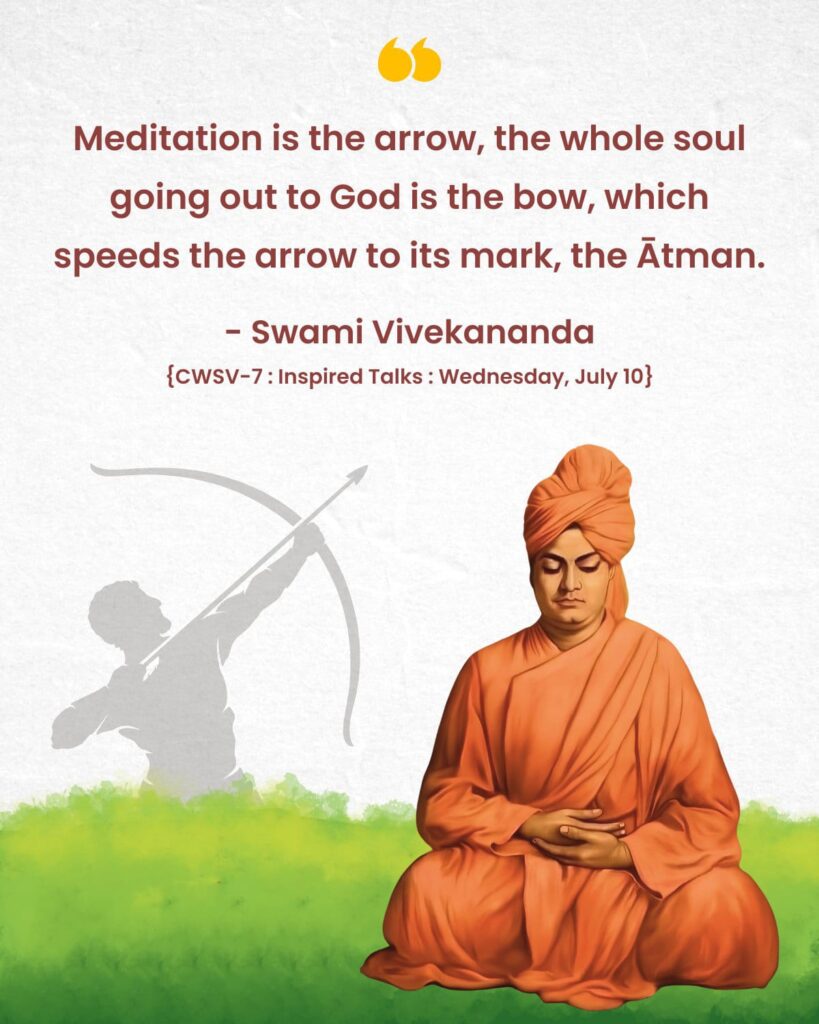
Om is the bow; the atman is the arrow; Brahman is said to be the mark. It is to be struck by an undistracted mind. Then the atman becomes one with Brahman, as the arrow with the target.
Commentary:
Pranava, Omkara is the bow. It was said earlier that Upanishadic knowledge is the bow. Now it is said that Pranava is the bow. The idea is that the Pranava, or Om, is the essence of Upanishadic knowledge. The Mandukya Upanishad is supposed to be the quintessence of all the Upanishads. Mandukyam ekam evalam mumukshunam vimuktaye (Muktika 1.27): For the sake of the liberation of the spirit, the Mandukya Upanishad alone is sufficient. This is a statement made in the Muktika Upanishad. Now, the Mandukya Upanishad is nothing but an exposition of Pranava. So in a sense it means the quintessence of Upanishadic teachings is Omkara, and so there is a pertinence here. It is appropriate that this verse says that Pranava, or Omkara, is the bow, equal to saying that Upanishadic knowledge is the bow.
Ātmā: The individual soul which seeks liberation is the arrow. Brahman is the target. With great concentration, with unwavering attention, you must aim this arrow on that object. As the arrow merges in the object by striking it directly, the Atman, this individual, this mind, has to get dissolved in that object. The concentration of the archer in respect of a target is well known. He does not know what is happening to him on either side. His ability to concentrate on one point is such that he will not see anything other than the object.
There is an illustration in the Mahabharata. During the tournament in which Drona tested the archery of the Pandavas and the Kauravas, he hung a little wooden bird on a branch of a tree. The image had all the features of a bird, such as eyes, beak, etc. The idea was that the archer should hit only the eye, not any other part of the bird, and he should see only that. The eye of the archer should concentrate itself on only the eye of the bird, and he should not go on thinking varieties of things.
Drona called Yudhishthira. “Come on. What do you see there?”
“I see a bird on the tree,” replied Yudhisththira.
“No. You are no good. Go to that side,” said Drona.
Then he called Bhima. “What do you see?”
“I see a bird tied to a branch of a tree.”
“No good. Go that side.”
Then he tested the other two brothers, and they also failed.
Then Arjuna was called and asked, “What do you see?”
“I see a black spot, and I see nothing else,” he replied.
That is the concentration that is expected in meditation on Brahman. It has already been mentioned that it is very subtle. How can the gross mind, which is accustomed to thinking of objects, succeed in thinking of subtle things? Brahman is subtle because of its universality on one hand and its inwardness on the other hand. The combination of these two aspects is very difficult to consider in the mind. Either we think of an expanse or we think something inside us. It is not merely an expanse outside, and it is also not something sitting inside us. It is a blend of the inwardness of subjectivity together with the expanse of objectivity, the infinity. As these two thoughts cannot combine easily, it is hard for the mind to concentrate on Brahman. It can concentrate on a form—on idols, on concepts, on an image that it places before itself—because it is outside. But Brahman is not outside. How will you concentrate on it? Apramattena veddhavyam: Very cautious you have to be, very careful. Do not be in a hurry. Then your mind will unite itself with the object of your meditation as the arrow merges into the object.
Sri Ramakrishna Says —
Sri Ramakrishna then explained the sacred Word “Om” and the true Knowledge of Brahman and the state of mind after the attainment of Brahma jnana.
MASTER: “The sound Om is Brahman. The rishis and sages practised austerity to realise that Sound-Brahman. After attaining perfection one hears the sound of this eternal Word rising spontaneously from the navel.
“‘What will you gain’, some sages ask, ‘by merely hearing this sound?’ You hear the roar of the ocean from a distance. By following the roar you can reach the ocean. As long as there is the roar, there must also be the ocean. By following the trail of Om you attain Brahman, of which the Word is the symbol. That Brahman has been described by the Vedas as the ultimate goal. But such vision is not possible as long as you are conscious of your ego. A man realises Brahman only when he feels neither ‘I’ nor ‘you’, neither ‘one’ nor ‘many’.
“Think of the sun and of ten jars filled with water. The sun is reflected in each jar. At first you see one real sun and ten reflected ones. If you break nine of the jars, there will remain only the real sun and one reflection. Each jar represents a jiva. Following the reflection one can find the real sun. Through the individual soul one can reach the Supreme Soul. Through spiritual discipline the individual soul can get the vision of the Supreme Soul. What remains when the last jar is broken cannot be described.
“The jiva at first remains in a state of ignorance. He is not conscious of God, but of the multiplicity. He sees many things around him. On attaining Knowledge he becomes conscious that God dwells in all beings. Suppose a man has a thorn in the sole of his foot. He gets another thorn and takes out the first one. In other words, he removes the thorn of ajnana, ignorance, by means of the thorn of jnana, knowledge. But on attaining vijnana, he discards both thorns, knowledge and ignorance. Then he talks intimately with God day and night. It is no mere vision of God.
“He who has merely heard of milk is ‘ignorant’. He who has seen milk has ‘knowledge’. But he who has drunk milk and been strengthened by it has attained vijnana.” (BG 15.17)
Thus the Master described his own state of mind to the devotees. He was indeed a vijnani. (Source: Gospel of Sri Ramakrishna)
—–
“When I meditated during my sadhana, I used to think of the unflickering flame of a lamp set in a windless place. (BG 6.19)
“In deep meditation a man is not at all conscious of the outer world. A hunter was aiming at a bird. A bridal procession passed along beside him, with the groom’s relatives and friends, music, carriages, and horses. It took a long time for the procession to pass the hunter, but he was not at all conscious of it. He did not know that the bridegroom had gone by. …..
“A person can achieve such single-mindedness in meditation that he will see nothing, hear nothing. He will not be conscious even of touch. A snake may crawl over his body, but he will not know it. Neither of them will be aware of the other.
“In deep meditation the sense-organs stop functioning; the mind does not look outward. It is like closing the gate of the outer court in a house. There are five objects of the senses: form, taste, smell, touch, and sound. They are all left outside. (Source: Gospel of Sri Ramakrishna)
Related Articles:
- Just as a lamp in a windless place does not flicker, so the disciplined mind of a yogi remains steady in meditation on the Supreme. (BG 6.19)